Drug Free Doesn't Mean Compassion-Free
Executive Summary
Unlock a step-by-step playbook for HR leaders who want a drug-free workplace and a people-first culture. This whitepaper covers stigma-busting communication, legal must-knows, a 90-day implementati...
Personalize This Whitepaper
Get examples, regulations, and recommendations tailored to your industry, state, and role.
Supporting Employees Through the Screening Process
From Policy to People: Why Employers Set the Tone
Drug-free workplace programs exist primarily to ensure the safety of employees, customers, and the public. But how those programs are implemented - the language used, the privacy offered, the support provided - flows directly from employer choices. More than two‑thirds of U.S. adults living with a substance‑use disorder (SUD) are employed, and most say fear of stigma keeps them silent at work (National Institute for Occupational Safety and Health [NIOSH], 2023). When organizations lead with empathy and clarity, testing stops feeling punitive and begins to reinforce a culture of safety, trust, and shared responsibility.
This whitepaper demonstrates how employers can integrate compassion into every stage of the screening process, ensuring policies remain fully compliant while employees feel respected and supported.

Understanding Employee Emotions - An Employer Responsibility
Stigma and silence create risk. A 2024 survey of 1,210 U.S. workers found that 54 % feel too embarrassed to seek help for substance‑use concerns at work - even though 35 % report that substance use affects them or a family member (Pelago, 2024). When testing is rolled out without context or sensitivity, it amplifies that anxiety, pushing issues underground and undermining the very safety the program is meant to protect.
Second‑chance talent is business‑critical. Millions of qualified candidates - people in recovery or with past convictions - are eager to work. Companies that embrace “recovery‑ready” or second‑chance hiring report lower turnover and higher engagement (U.S. Chamber of Commerce, 2024). Employers who frame testing as part of a supportive, opportunity‑rich culture attract and retain this motivated workforce segment.
Trauma‑informed practices matter. Observed urine collections (required in some DOT scenarios) can re‑traumatize workers with past abuse or incarceration histories. Privacy, plain‑language explanations, and choice wherever possible mitigate harm and maintain trust (Massachusetts Department of Public Health [MDPH], 2023).
Employer Action Points
Action
Why it Matters
Normalize open conversation about SUDs as a health issue.
Reduces stigma; encourages early disclosure and treatment.
Audit hiring policies for automatic disqualifications that conflict with second-chance goals.
Expands talent pool; support community impact goals.
Embed trauma-informed language in all testing communications.
Protects employee dignity; lowers anxiety and resistance.
Designing a Compassionate Screening Program - The Employer Playbook
Communicate with Transparency and Respect
- Advance notice. Use plain‑language emails/texts that explain why a test is required, what to expect, and employee rights. Automated reminders prevent surprises and demonstrate organizational fairness.
- Explain observed collections. When direct observation is federally mandated, a concise explanation of why and how preserves dignity (U.S. DOT §40.67).
- Invite questions. A brief Q&A window before collection shows openness and builds trust.
Safeguard Privacy and Dignity
- Provide private restrooms or stalls; if observation is required, assign a same‑gender observer positioned discreetly.
- Keep the process efficient: pre‑stage supplies, secure sinks/soap outside stalls (U.S. DOT §40.42).
- Post a one‑page “What to Expect” flyer (QR‑linked to the full policy) at collection sites.
Protect Confidentiality
Under U.S. DOT §40.321, test results are medical information and may not be shared beyond authorised personnel without written consent. Reinforce this policy in every employee‑facing document to prevent gossip or unintended disclosure.
Provide Immediate and Ongoing Support
- Pair any non‑negative result with a direct referral to an Employee Assistance Program (EAP) or community resource (SAMHSA, 2024).
- Offer flexible return‑to‑work plans that allow treatment without loss of income or status (National Drug‑Free Workplace Alliance [NDWA], 2024).
- Establish clear, written second‑chance paths - including timelines for re‑screening - rather than automatic termination.
Train Supervisors to Lead with Empathy
- Implement annual supervisor training that covers recognising impairment and initiating judgment‑free conversations (SAMHSA, 2024).
- Provide trauma‑informed conversation scripts and require partner clinics to follow similar language for consistency.
Quick‑Start Checklist for Employers
Step
Employer Goal
Practical Tool
Pre-Test Notice
Give every employee a 24-hour heads-up with a Q&A link.
Automated SMS/email workflow.
Private Collection
Ensure privacy; same-gender observer when mandated.
Site audit + provider contract language.
Secure Results
Limit access to authorized HR/Medical Review Officer (MRO) personnel.
Role-based permissions + audit trail.
Post-Test Support
Connect employees to EAP and establish re-screen plan.
One-click referral + scheduled follow-up.
Supervisor Training
Annual refresher on empathetic conversations and policy updates.
Micro-learning modules; certificate tracking.
Employers who implement the steps above achieve two simultaneous outcomes: stricter compliance and stronger employee loyalty. Compassionate testing isn’t an add‑on - it’s simply the most effective way to run the program you already need.
Legal and Ethical Considerations - Compassion Without Compromise
Even the most empathetic testing program will fail if it violates federal or state law. The good news? The same statutes that protect employees’ rights also give employers clear guardrails for creating fair, consistent policies.
ADA Confidentiality & “Need‑to‑Know”
The Americans with Disabilities Act (ADA) requires that any drug‑test results or medical information be stored separately from personnel files and shared only with individuals who truly need to know (e.g., the MRO or a limited HR contact) (EEOC, 2024). Publishing or casually discussing results exposes the company to discrimination claims and erodes employee trust.
Employer move: Keep a written “need‑to‑know” matrix that spells out exactly who can access which parts of the record and why. Review access logs quarterly.

OSHA & Anti‑Retaliation
OSHA’s 29 C.F.R. § 1904.35(b)(1)(iv) bars employers from using blanket, automatic post‑incident drug tests that could deter employees from reporting injuries. A 2018 interpretation letter clarifies that testing must be situationally relevant - you can’t test just because someone got hurt if substance use was unlikely to be a factor (OSHA, 2018).
Employer move: Build a short decision‑tree into your incident‑response protocol that asks, “Could impairment reasonably have contributed?” before ordering a test.
Common Pitfalls HR Teams Fall Into
Building a No‑Fear Culture
OSHA’s Recommended Practices for Anti‑Retaliation Programs outlines the core elements of a program where workers feel safe to speak up - including clear anti‑retaliation language, multiple reporting channels, and supervisor accountability (OSHA, 2017).
Employer move: Add a line in every test‑notification email reminding employees that participation is protected and retaliation is prohibited.
Navigating State Cannabis Laws
Recreational or medical cannabis is now legal in most U.S. states, but federal regulations (DOT, federal contractors) still require abstinence in safety‑sensitive roles. HR professionals must reconcile these layers while avoiding blanket bans that could run afoul of state law (SHRM, 2024).
Employer move: Maintain a location‑based matrix of cannabis rules and update it quarterly; ensure the policy distinguishes between use and impairment.
Documentation & Consistency
Courts look for consistency. Apply the same procedure, timeline, and disciplinary steps for every role and location unless a documented regulatory difference exists. Consistent documentation protects both the employer and the employee.
Employer move: Use electronic workflows that time‑stamp each action - from notification to result review - so you can demonstrate fairness if challenged.
Partnering for Compassion-Turning Policy into Practice with BlueHive
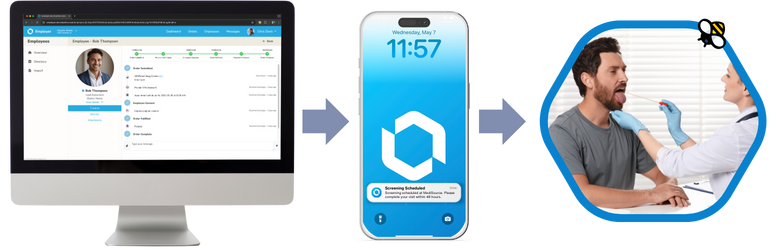
Employers need a single workspace that keeps testing tasks organised, transparent, and secure. BlueHive focuses on doing the basics flawlessly-so your team can deliver a people‑first experience without adding headcount or cobbling together point solutions.
Reduce Administrative Lift
- Automated scheduling & reminders: Upload your roster, set a testing window, and BlueHive sends plain‑language SMS/email notifications-cutting follow‑up calls and spreadsheet wrangling.
- Smart supervisor alerts: When a non‑negative result is verified by the Medical Review Officer (MRO), designated leaders receive a secure notification alongside next‑step guidance. Audit logs track every view for accountability.
Employee‑Friendly Communication
Mobile‑first by default: Most frontline staff rely on smartphones; BlueHive provides step‑by‑step instructions via secure links-no passwords or app downloads required.
Provider Network
- Access more than 20,000 collection sites nationwide.
- Filter by location and collection method (e.g., oral fluid, urine, hair).

Secure Data - With Controlled Downloads
- All test results and supporting documents are encrypted in transit and at rest.
- Role‑based permissions let you decide who can view, download, or forward each file, and every download can be time‑stamped for your compliance records.
Actionable Dashboards
- Monitor completion rates, average turnaround time, and no‑show trends in real time.
- Export CSV or PDF summaries to satisfy auditors or share progress with leadership.
Fast Implementation & Ongoing Support
- White‑glove onboarding: Most employers go live in 15 business days or less.
- Live training and on‑demand refreshers for HR, supervisors, and EAP liaisons.
By handling the logistics - notice delivery, provider coordination, secure record‑keeping - BlueHive lets you focus on what matters most: fostering a drug‑free and people‑first culture.
Conclusion: Drug‑Free, People‑First - A Call to Action
Employers no longer have to choose between a drug‑free workplace and a people‑first culture. As the evidence throughout this whitepaper shows, organizations that blend trauma‑informed communication, airtight compliance, and proactive support enjoy measurably better retention, safety, and brand reputation (Deloitte, 2024; NIOSH, 2023). Your next step is simple: turn the checklist in Section 7 into a project plan and leverage platforms - like BlueHive - that make compassionate testing the default, not an exception.
Imagine the impact in one year:
- No‑show rates under 3 %;
- Average test cycle time cut in half;
- Second‑chance hire retention above 90 %; and
- A workforce that trusts leadership to protect both their safety and their dignity.
The journey starts with a single policy review. BlueHive’s team is ready to map your existing processes, automate the heavy lifting, and train supervisors to lead with empathy. Reach out at [email protected] to schedule a 30‑minute strategy session.
Your employees - and your bottom line - will thank you.
Download the Whitepaper:
Loading flipbook...
Sources
- Deloitte Development LLC. (2024, July). Power human resource service delivery with AI. https://www2.deloitte.com/content/dam/Deloitte/us/Documents/public-sector/gps-hc-genai-powered-hr-final.pdf
- Equal Employment Opportunity Commission. (2024). Enforcement guidance on disability-related inquiries and medical examinations of employees under the ADA. https://www.eeoc.gov/laws/guidance/enforcement-guidance-disability-related-inquiries-and-medical-examinations-employees
- Massachusetts Department of Public Health, Bureau of Substance Addiction Services. (2023, June). BSAS practice guidance: Trauma-informed care as a treatment philosophy. https://www.mass.gov/doc/trauma-informed-care-practice-guidance-2023/download
- National Drug-Free Workplace Alliance. (2024, December 30). Substance use in the workplace: Reflecting on 2024 and preparing for 2025. https://www.ndwa.org/news/substance-use-in-the-workplace-reflecting-on-2024-and-preparing-for-2025/
- National Institute for Occupational Safety and Health. (2023, December 21). Workplace supported recovery. Centers for Disease Control and Prevention. https://www.cdc.gov/niosh/substance-use/workplace-supported-recovery/index.html
- Occupational Safety and Health Administration. (2017). Recommended practices for anti-retaliation programs (OSHA 3905). https://www.osha.gov/sites/default/files/publications/OSHA3905.pdf
- Occupational Safety and Health Administration. (2018, October 11). Standard Interpretation: Clarification of OSHA’s position on workplace incentive programs and post-incident drug testing. https://www.osha.gov/laws-regs/standardinterpretations/2018-10-11
- Pelago. (2024, August 8). National survey finds U.S. employers and workers primed for honest dialogue about drug and alcohol use amid substance use crisis. https://www.pelagohealth.com/company/press-release/national-survey-finds-u-s-employers-and-workers-primed-for-honest-dialogue-about-drug-and-alcohol-use-amid-substance-use-crisis/
- Society for Human Resource Management. (2024, January 10). State of the Workplace Study 2023–2024. https://www.shrm.org/content/dam/en/shrm/research/2023-2024-State-of-the-Workplace-Report.pdf
- Society for Human Resource Management. (2024). Marijuana & the workplace. https://www.shrm.org/topics-tools/topics/marijuana-cannabis-workplace
- Substance Abuse and Mental Health Services Administration. (2024, December 13). Drug-Free Workplace Toolkit. https://www.samhsa.gov/substance-use/drug-free-workplace/employer-resources/toolkit
- U.S. Chamber of Commerce. (2024, September 18). The workforce impact of second-chance hiring. https://www.uschamber.com/workforce/data-deep-dive-the-workforce-impact-of-second-chance-hiring-3
- U.S. Department of Transportation, Office of Drug & Alcohol Policy and Compliance. (2016, April 7). 49 CFR Part 40 §40.321: Confidentiality and release of information. https://www.transportation.gov/odapc/part40/40-321
- U.S. Department of Transportation, Office of Drug & Alcohol Policy and Compliance. (2016, April 7). 49 CFR Part 40 §40.42: Urine specimen collection procedures. https://www.transportation.gov/odapc/part40/40-42
- U.S. Department of Transportation, Office of Drug & Alcohol Policy and Compliance. (2024, June 25). 49 CFR Part 40 §40.67: Directly observed collections. https://www.transportation.gov/odapc/part40/40-67
Stay Current on Drug Testing Regulations
State regulations change frequently. Track the latest updates in our Compliance Watch.
View Drug Testing Regulations Updates
Content Developer
71 articles
Chris Davis is a content developer at BlueHive, covering occupational health compliance, workplace safety, and industry best practices.
Related Services
Related White Papers
 White Paper
Your Hiring Process is a Candidate Experience: How Occupational Health Steps Can Build Trust
Chris Davis·44 min read White Paper
Top 5 Occupational Health Compliance Mistakes HR Teams Still Make in 2025
Chris Davis·5 min read White Paper
The Employee Health Playbook: A Step-by-Step Checklist for Onboarding
Chris Davis·6 min readReady to streamline your occupational health program?
BlueHive connects you to 20,000+ clinics nationwide with real-time scheduling and results.