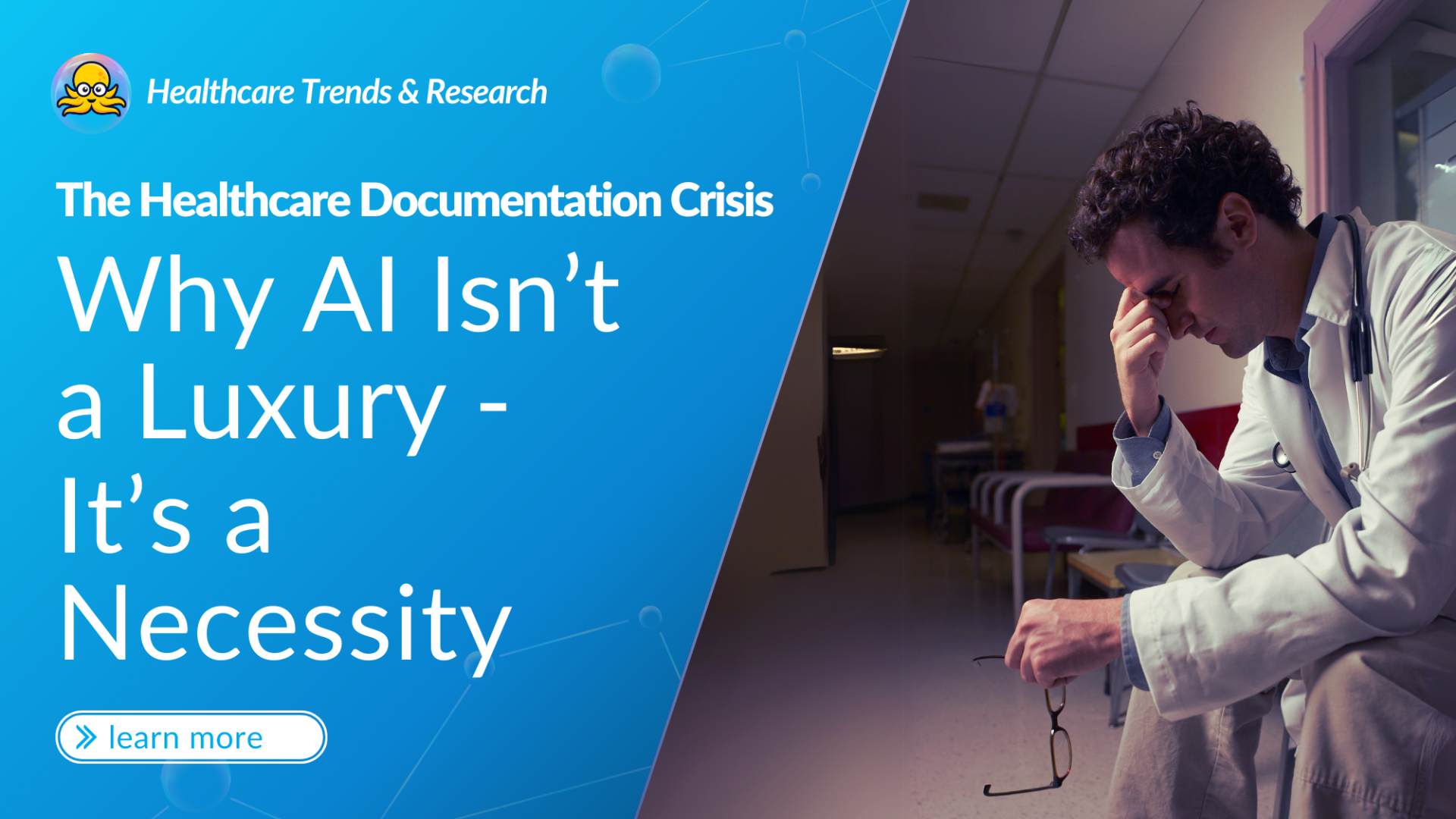
The Healthcare Documentation Crisis: Why AI Isn't a Luxury — It's a Necessity
Executive Summary
For every hour spent with a patient, physicians dedicate nearly two additional hours to documentation. 63% of physicians report burnout. AI offers the means to reclaim the most valuable resource in medicine: time.
Personalize This Whitepaper
Get examples, regulations, and recommendations tailored to your industry, state, and role.
Medicine Is Losing Its Soul to Documentation. Can We Get It Back?
Midway through a busy clinic day, Dr. Jeff Margolis, a practicing medical oncologist in Royal Oak, Michigan, and president of Michigan Health Professionals—the largest private practice in the state with nearly 500 physicians—shares a candid reflection on modern medicine. When asked, "How do you keep your head on straight?" He responds candidly:
On keeping perspective amid mounting administrative demands
“Sometimes I don't know. But the difference between me and a lot of administrators is I'm actually seeing patients every day.”
Dr. Jeff Margolis
President, Michigan Health Professionals
This highlights a core challenge in today's healthcare: while many administrators are mired in paperwork, dedicated clinicians like Dr. Margolis continue to focus on patient care. Yet even the most committed physicians find that the shift from paper charts to electronic health records (EHRs) has not been entirely beneficial. With endless tick boxes, template fields, and mouse clicks, the very soul of medicine risks being lost in a labyrinth of administrative tasks.
Unfortunately, Dr. Margolis isn't alone. The modern healthcare system forces countless providers to spend more time staring at electronic charts than engaging directly with patients. Recent studies by the American Medical Association, Mayo Clinic, and others illustrate the scope of the problem:
- For every hour spent with a patient, physicians dedicate nearly two additional hours to documentation. In a detailed time-and-motion study led by Dr. Christine Sinsky, researchers found that EHR tasks and desk work frequently overshadow face-to-face interactions, underscoring the unsustainable nature of current documentation demands.
- 63% of physicians report burnout, citing emotional exhaustion and detachment from their work—a figure that reflects a significant rise over the years and points to escalating psychological stress in healthcare.
- Administrative burden is the second-leading cause of physician burnout, with bureaucratic tasks and documentation overload fueling chronic fatigue and disconnection from patient care.
- With annual expenditures on administrative complexity estimated at $286 billion, this financial drain diverts vital resources away from patient-facing activities and exacerbates systemic inefficiencies.
The Documentation Burden by the Numbers
How administrative complexity is eroding physician well-being and patient care
Documentation-to-Patient Ratio
Hours spent documenting for every hour of patient care
Physician Burnout Rate
Of physicians report burnout from documentation burden
Annual Admin Waste
Spent on administrative complexity in US healthcare
EHR Clicks Per Shift
Mouse clicks logged by ER physicians per shift
And while countless "fixes" have been proposed, many only add new layers of complexity.
The "Fixes" That Are Making the Problem Worse
EHRs: A Necessary Tool That Became a Burden
When Electronic Health Records (EHRs) first arrived, they promised a new era of clarity and accuracy: goodbye, illegible handwriting and missing charts. Yet for Dr. Margolis, who remembers the transition from paper charts, it felt like a giant step backward:
On the shift from paper to electronic records
“On paper charts, I could look a patient in the eye, talk with them, and just jot down occasional notes. I was a doctor first, and the chart came second. With EMRs, it became clear that the EMR had to be taken care of first, and sometimes the patient felt secondary.”
Dr. Jeff Margolis
President, Michigan Health Professionals
Statistics confirm his frustration:
- Primary care physicians devote about half of their workday—5.9 hours out of 11.4—to EHR-related tasks, leaving less time for face-to-face patient interactions.
- Emergency physicians in a community hospital logged roughly 4,000 mouse clicks per shift just to complete EHR documentation tasks, illustrating the time-intensive nature of current systems.
Cultural Reflections on the Documentation Crisis
Recall a time when a doctor's note was a testament to empathy and human connection? Now it often resembles a "bloated ransom note" engineered to meet bureaucratic demands. The stark reality is that modern documentation systems have stripped physicians of their role as caregivers, exacting a heavy toll on patient outcomes, financial stability, and the professional spirit of the field. Burnout is often cited as a symptom, yet beneath that label lies a profound moral injury that erodes the very ethics that compelled physicians to dedicate their lives to healing.
Scribes and Dictation: A Band-Aid, Not a Cure
To offset the burden, many providers turn to medical scribes or voice dictation software. While these can temporarily ease some burdens, they bring their own headaches. Scribes must be hired and trained, dictation often requires heavy edits, and neither addresses the root cause of documentation overload.
Documentation Approaches Compared
How traditional solutions stack up against AI-powered ambient documentation
EHR Only
7–10 minutes of typing
Scribes
4–5 min (scribe handles it)
Dictation
5–7 min + editing time
AI Ambient
< 1 min review time
EHR Only
1–2 hours/night typical
Scribes
Reduced but not eliminated
Dictation
Still requires editing at home
AI Ambient
Near zero — notes done at visit end
EHR Only
Minimal — screen-focused
Scribes
Good — scribe takes notes
Dictation
Moderate — dictating during visit
AI Ambient
Maximum — fully present
EHR Only
~83% baseline
Scribes
Varies by scribe training
Dictation
Requires manual code entry
AI Ambient
~92% with AI-assisted coding
EHR Only
Built into EHR license
Scribes
$36K–$50K per scribe
Dictation
$3K–$12K for software
AI Ambient
Fraction of scribe cost
EHR Only
Scales with licenses
Scribes
Linear — 1 scribe per doctor
Dictation
Good — software-based
AI Ambient
Unlimited — SaaS model
EHR Only
Extensive EHR onboarding
Scribes
2–3 months per new scribe
Dictation
Moderate voice training
AI Ambient
Minimal — works from day one
EHR Only
Low — #1 burnout driver
Scribes
High but staffing-dependent
Dictation
Mixed — editing fatigue
AI Ambient
High — "liberating"
The Real Cost: Patient Satisfaction, Revenue Loss, and Burnout
As documentation demands pile up, the consequences can be severe. Wrestling with EHRs undermines the core mission of healthcare: to heal. The ripple effects are far-reaching:
-
Medical errors are recognized as the third leading cause of death in the United States, surpassed only by heart disease and cancer. In a system flooded with overlapping tabs, dropdowns, and multiple logins, critical lab results or medication changes can be overlooked. This fragmented documentation environment can delay diagnoses, complicate care coordination, and in the worst cases, contribute to adverse patient events.
-
Complex billing and coding errors can lead to major financial losses, as small mistakes like missing codes or incomplete entries can ripple into denied claims and reduced reimbursements. AI has the potential to streamline health financing and minimize administrative pitfalls by better handling massive data sets, ultimately boosting financial stability for hospitals and private practices alike.
-
Face-to-face interaction diminishes when physicians focus heavily on screen-based tasks, relegating patient engagement to a secondary role. Studies show that when patients feel their doctor is distracted or rushed, they rate their care experience lower. Eye contact, personal conversation, and the overall "human touch" often wane when providers are tied to EHR documentation, eroding bedside rapport and potentially undermining trust, communication, and clinical outcomes.
For Dr. Margolis, the real benefit of reducing documentation is clear: it allows him to reconnect with his patients. He shares that Ozwell [formerly BlueHive AI] has enabled him to "just look at the patient, talk, and be a doctor," illustrating how even modest gains in efficiency can restore the essential human connection at the heart of healthcare.
Is Documentation Burnout Affecting Your Practice?
5 quick questions to assess your organization's documentation burden
Question 1 of 5
How much of your providers’ workday is spent on documentation vs. patient care?
From Burden to Breakthrough: AI's Role in Healthcare
For years, artificial intelligence in healthcare was considered a lofty, futuristic concept—promising, yet not ready for prime time. That conversation has changed. AI is already delivering real, measurable results:
- In a large retrospective study of nearly 30,000 outpatient visits in ophthalmology, the use of scribes reduced physicians' total documentation time from 7.6 minutes per note to 4.7 minutes—an overall decrease of nearly 38%.
- An AI-powered ICD-10 coding system was shown to raise coding accuracy from 83% to 92%. This boost in accuracy means that mistakes in billing are likely to drop and healthcare providers can more easily meet regulatory standards.
- In an ambulatory urology practice, the introduction of medical scribes led to higher patient satisfaction scores; patients felt they received more focused and personalized care when physicians were less distracted by documentation tasks.
A "Game Changer" for Dr. Margolis
After just two weeks of using Ozwell [formerly BlueHive AI], Dr. Margolis sums up the impact in one word: "liberating."
On adopting AI-powered documentation
“It was the first time it felt like we got it right. I could stop staring at the monitor and just be a doctor. BlueHive did the documentation part for me.”
Dr. Jeff Margolis
President, Michigan Health Professionals
On the measurable impact of AI documentation
“Most of us who switched gained an hour or two hours back of our day. It has just been remarkable how much it's improved our patient care and allowed us to go back to being doctors.”
Dr. Jeff Margolis
President, Michigan Health Professionals
A Day in the Doctor's Shoes
Toggle between a typical day with and without AI documentation
Drowning in Overnight Notes
😰 StressedArrives early to review charts from the night before. Spends 45 minutes scrolling through EHR tabs, decoding notes from covering physicians, and pre-loading templates for the day’s 22 patients.
7:00 AM — Chart Review & Prep
Built to Work With You, Not Against You
Adopting new technology often comes with a major concern: workflow disruption. Healthcare organizations can't afford to rip out their current systems or retrain entire teams overnight, which is why Ozwell is designed to enhance, not replace, existing workflows.
Like an extra set of capable hands working in the background, Ozwell effortlessly manages documentation tasks, ensuring providers can focus on patients—not paperwork.
Ozwell is seamless and adaptable:
- Works with existing health systems including Enterprise Health, WebChart & BlueHive as part of a larger ecosystem
- Capability to expand to other systems with flexible interoperability
- Operable as a standalone AI-powered assistant for those without an EHR or EMR
Because the solution to documentation overload isn't just to use another system—it's a smarter way to use the ones we already have.
Final Thoughts: AI Is the Way Forward
In today's healthcare landscape, where physician shortages and administrative burdens drive burnout, the answer isn't to simply demand more effort—it's to embrace smarter solutions. AI offers the means to reclaim the most valuable resource in medicine: time. Time that can be redirected from what feels like endless paperwork to meaningful patient care.
Dr. Jeff Margolis's testimonial underscores this shift, as he describes how AI has given him the ability to refocus on what truly matters.
The bottom line: AI isn't a replacement for physicians—it's a restoration of their purpose. Let them practice medicine, not data entry.
References
- Arndt, B. G., et al. (2017). Tethered to the EHR: Primary care physician workload assessment using EHR event log data and time-motion observations. Annals of Family Medicine, 15(5), 419-426.
- BlueHive. (2024). BlueHive AI Testimonial – Jeffrey Margolis, M.D. [Video]. YouTube.
- Chen, P.-F., et al. (2021). Automatic ICD-10 coding and training system: Deep neural network based on supervised learning. JMIR Medical Informatics, 9(8), e23230.
- Dusek, H. L., et al. (2021). Clinical Documentation During Scribed and Non-scribed Ophthalmology Office Visits. Ophthalmology Science, 1(4), 100088.
- Hill, R. G., Jr., et al. (2013). 4000 clicks: A productivity analysis of electronic medical records in a community hospital ED. The American Journal of Emergency Medicine, 31(11), 1591-1594.
- Honavar, S. G. (2020). Electronic medical records – The good, the bad and the ugly. Indian Journal of Ophthalmology, 68(3), 417-419.
- Koshy, S., et al. (2010). Scribes in an ambulatory urology practice: Patient and physician satisfaction. Journal of Urology, 184(1), 258-262.
- Makary, M. A., & Daniel, M. (2016). Medical error—the third leading cause of death in the US. BMJ, 353, i2139.
- Ramezani, M., et al. (2023). The application of artificial intelligence in health financing: A scoping review.
- Shanafelt, T. D., et al. (2022). Changes in burnout and satisfaction with work-life integration in physicians. Mayo Clinic Proceedings, 97(8), 1599-1614.
- Shrank, W. H., et al. (2019). Waste in the US health care system: Estimated costs and potential for savings. JAMA, 322(15), 1501-1509.
- Sinsky, C., et al. (2016). Allocation of physician time in ambulatory practice: A time and motion study in 4 specialties. Annals of Internal Medicine, 165(11), 753-760.

Director Of Marketing
30 articles
Evelyna Bellamy leads marketing at BlueHive, driving brand strategy and thought leadership in the occupational health space.
Related White Papers




Ready to streamline your occupational health program?
BlueHive connects you to 20,000+ clinics nationwide with real-time scheduling and results.