


Health systems, clinics, and long-term care organizations are facing a long-running workforce crunch. National data show that more than a quarter of health care workers and 41 percent of nurses plan to leave their jobs within two years, which deepens shortages and strains teams that are already stretched (Health Resources and Services Administration [HRSA], 2024). Short staffing is widespread across the care continuum, driven by aging populations, burnout, and uneven distribution of clinicians (National Institute for Health Care Management [NIHCM], 2025).
Demand for talent is not slowing down. Health care employment is projected to grow much faster than average through 2033, with about 1.9 million openings a year once you combine new jobs with roles vacated by workers leaving the field (NSI Nursing Solutions, 2025). For HR and staffing leaders, that means more requisitions, more pressure to move quickly, and more scrutiny from operational leaders who just see open shifts.
Even when recruiters source strong candidates, many hiring journeys bog down at the same point: pre-employment and onboarding. Health care roles require drug testing, TB screening, immunization verification, titers, respirator questionnaires, and, in some cases, role-specific physical exams before anyone can safely step onto a unit. These steps protect patients and staff, yet when they are scattered across disconnected systems and vendor portals, they quietly add days or weeks to the time to start.

Highly sought-after candidates rarely wait that long. If appointments are difficult to schedule, instructions are confusing, or no one can explain their status in the clearance process, candidates are more likely to ghost, accept a competing offer, or drop out entirely (Cuellar, 2024; NIHCM, 2025).
This whitepaper focuses on that critical but often overlooked stretch of the hiring journey: everything between “You are hired” and “Here is your badge.”
We will examine how occupational health screenings, background checks, immunization verification, and credentialing slow staffing pipelines, what that delay costs, and how modern occupational health platforms like BlueHive can turn compliance from a bottleneck into an advantage.
Download the Whitepaper
Where Staffing Pipelines Leak:The Hidden Friction Points
On paper, the steps from offer to first shift seem simple: background check, health screenings, paperwork, training, and orientation. In reality, small inefficiencies at each step pile up.
Fragmented Workflows
In many organizations, HR owns offers and background checks, occupational health manages medical clearance, and hiring managers handle pieces informally by email. When each group uses different tools, it becomes harder to share information and keep track of status. Industry guidance notes that manual, fragmented workflows cause missed or duplicated tests and slow approvals (Cority, 2025).
Healthcare screening resources emphasize that pre-employment screening is more intensive in healthcare than other sectors and that using spreadsheets and email to track it turns necessary checks into bottlenecks (HireRight, 2024).
Slow Drug Screens and Health Testing
Drug tests and occupational health exams are often the critical checkpoint between “offer accepted” and “first day.” Poorly coordinated scheduling, limited clinic availability, and manual result tracking can delay clearance unnecessarily (Cisive, 2025). General HR screening guides report that high volumes, missing documents, and back and forth with third-party vendors frequently extend turnaround times (Sapphire Check, 2025; Top10.com, 2025).
For internal talent teams and staffing agencies, these delays show up as longer time to fill, higher candidate drop off, and more frustration from clinical leaders who only see unfilled shifts.
Background Checks and Credentialing Lag
Healthcare background checks usually go beyond basic criminal searches to include sex offender registries, professional license verification, exclusion lists, and sometimes abuse and neglect registries for roles serving vulnerable populations (HIPAA Journal, 2025). Screening and credentialing providers note that manually verifying licenses and credentials can significantly extend time to hire (Vetty, 2025).
Research on the health workforce also notes that complex background check policies can unintentionally delay or exclude qualified workers, especially in long-term care, home health, and behavioral health, where staffing needs are acute (Dunlap, Basye, & Skillman, 2021).

Communication Gaps and Candidate Ghosting
Even when the clinical workflow is sound, poor communication can make the process feel confusing. Ghosting has become common at every stage of healthcare recruitment. Recent analyses report that nearly half of healthcare job seekers have ghosted an employer during the hiring process (Integral Recruiting, 2025). Other sources directly connect ghosting to slow response times and unclear expectations (ATC Healthcare, 2025; Healthcare Business Today, 2024).
Common pain points are:
- No clear timeline for screening and clearance
- Long gaps between “we need you to complete this test” and any follow-up
- No simple way for candidates to check status
In a competitive market, candidates who feel in the dark will often choose the employer that offers a faster, more predictable path to the floor.
Volume, Complexity, and Process Drag
Healthcare organizations rarely hire one person at a time. Multiple candidates are moving through the pipeline for the same roles, which multiplies the number of screenings, background checks, and credentialing workflows in motion. High-volume hiring strains manual processes and slows everything down.
Benchmark data show that time to fill for medical roles is heavily influenced by credentialing requirements, compliance workflows, and internal approvals, not only by sourcing and interviews. Organizations that automate verification and compliance checks significantly reduce bottlenecks and maintain quality at scale.
In short, staffing teams are not only battling a talent shortage. They are battling process drag. Every extra form, email, or status check adds friction, which shows up as longer time to fill, higher drop off after offer, and more last-minute schedule gaps.
The Compliance Journey From Offer to First Shift
To fix a leaky pipeline, you need a clear map. Onboarding guides recommend building structured workflows that outline tasks, owners, and dependencies for each step of pre-employment screening and onboarding, with health care needing extra attention because of its added regulatory and clinical checks.
A simplified journey looks like this:
1. Offer Accepted
Candidates should immediately receive a clear checklist: required screenings, where to complete them, typical timelines, and a contact for questions. Checklists and portals help candidates start right away instead of waiting on scattered emails.
2. Background Check and License Verification
Employers run criminal checks, exclusion list searches, and license verification. Because these checks are more complex in health care, automation and tracking are critical to avoid surprises late in the process.
3. Occupational Health Screening and Immunization Review
Employers review immunization records, TB status, drug test results, and any required physical or respirator clearance. Guidance from the Centers for Disease Control and Prevention (CDC) emphasizes that health care personnel should be medically fit for duty and have documented immunity and vaccinations to protect patients and colleagues (Centers for Disease Control and Prevention [CDC], 2023).
4. Paperwork, Training, and Policy Acknowledgments
New hires complete employment forms, benefit elections, policy acknowledgments, and required training. When these tasks are scattered across systems, completion rates drop, and HR spends more time chasing signatures than supporting candidates.
5. Clearance Decision and Start Date
HR or occupational health reviews everything: background results, licenses, immunizations, exams, and training. Unclear ownership at this stage is a common cause of delay, especially when teams debate whether a missing titer, expiring license, or partial training can be resolved before start (NIHCM, 2025; Viva IT, 2025a).
Once staff start work, compliance continues through periodic TB testing, booster doses, license renewals, and surveillance exams. Best practice increasingly frames onboarding as the beginning of a continuous compliance lifecycle, not a one-time event.
Across this journey, the biggest issues are not clinical standards. They are handoffs: from recruiter to HR, HR to background vendor, HR to occupational health, clinics back to HR, and HR to scheduling. Workforce analyses highlight that process inefficiencies and administrative burden significantly delay getting clinicians to the bedside (NIHCM, 2025).

Why Compliance Delays Matter for Business Outcomes
Compliance steps are easy to treat as fixed costs. In reality, they are one of the biggest levers you have to improve staffing, finances, and staff well-being.
Time to Fill and Time to Start
Surveys show it often takes between about two and three months to recruit and fill registered nurse roles, with many facilities reporting 59 to 109 days depending on specialty (NursingCECentral, 2024). Other benchmarks place median time to hire in healthcare at roughly 41 days, with organizations that use modern tools and automation hiring significantly faster (SmartRecruiters, 2025). State-level studies confirm that many hospitals still need more than 60 days to fill some RN positions, although that is improving as processes modernize.
A significant slice of this timeline is spent waiting on clearances, not sourcing. Shortening the compliance phase by even seven to fourteen days can mean fewer shifts covered with overtime or agency staff and less time for candidates to accept competing offers.

Cost of Vacancy, Overtime, and Turnover
Open positions are filled somehow, usually by existing staff working harder or by expensive supplemental labor. Ongoing vacancies increase workload, strain mental health, and fuel burnout among remaining staff (People Element, 2024; ScienceDaily, 2025).
The financial impact is substantial. Analyses estimate that the average cost of turnover for a single staff RN now exceeds 56,000 dollars, once you account for recruitment, onboarding, and lost productivity (Becker’s Hospital Review, 2025; Staff Relief Inc., 2024). A longer time to start directly prolongs vacancy, which drives overtime, agency spend, and burnout that can trigger yet more turnover.
Cost per Hire and Abandoned Candidates
Average cost per hire across industries typically ranges from a few thousand dollars to five figures for specialized roles (ReadyToHire, 2025). In healthcare, where roles are often specialized and heavily regulated, the cost per hire for nurses and advanced practitioners tends to land on the high end of that range.
When candidates drop out during pre-employment screening, organizations lose not only a name on a spreadsheet but also:
- Vendor fees for background and health tests
- Recruiter and hiring manager time
- Weeks of vacancy time
Clear, streamlined compliance steps increase the percentage of offers that convert to real start dates, improving the return on every recruiting dollar.
Retention, Engagement, and Employer Brand
Onboarding does more than get forms signed. It shapes how long people stay. Studies show strong onboarding programs can boost new hire retention by more than 60 percent and increase productivity (UrbanBound, 2024; The Medicus Firm, 2023). Broader research links high-quality onboarding with stronger identification with the organization, better well-being, and lower turnover intention (Fachrunnisa, Adhiatma, & Lukman, 2024). In healthcare specifically, employees often decide in the first few months whether they see a long-term future with an employer, and chaotic onboarding pushes many out sooner (Insight Global, 2024).
When pre-employment health and compliance are organized and transparent, the organization sends a clear message: we value your time, we take safety seriously, and we use modern tools instead of fax machines. Over time, that experience strengthens your employer brand and makes it easier to attract and retain staff.
How to Move From Short-Staffed to Fully Supported
The good news is that you do not have to redesign everything from scratch. You can borrow proven patterns from occupational health, employee health, and onboarding platforms, then apply them to your staffing pipeline.
Industry guidance highlights the same core strategy: centralize data, automate manual steps, and give HR real-time visibility into each candidate’s progress.
Centralize Occupational Health and Compliance Data
Modern occupational health and employee health systems act as a central hub for pre-employment exams, surveillance, immunizations, and regulatory reporting, rather than scattering information across departments (Sprypt, 2025). Employee health solutions stress the value of central databases for screenings, immunizations, and work restrictions, with access controls that align with infection prevention recommendations.
For HR and staffing teams, a single source of truth means:
- One dashboard that shows who is cleared, in progress, or stuck
- One set of rules for which tests apply to which roles or clients
- One place to go during audits
BlueHive is built around this idea, giving HR a unified view of drug testing, occupational health, immunization status, and clearance rather than forcing them to chase data across multiple portals.
Connect to a Strong Provider and Lab Network
Workflows still stall if candidates cannot get appointments. Occupational health platforms emphasize being able to order drug tests and physicals in seconds while tapping into national clinic and lab networks to avoid manual coordination. Drug testing providers describe similar advantages when employers can place orders, send candidates, and receive results through a single online portal connected to large occupational health networks. Software review sites highlight that drug testing systems increasingly automate scheduling, integrate with lab databases, and track results for compliance.
In practice, a platform like BlueHive can:
- Route candidates to nearby in-network clinics
- Standardize which panels or exam types are used for each role
- Return results directly into a clearance dashboard
This turns “We are waiting on the clinic” into a scheduled appointment and a predictable turnaround time.
Automate Immunization Tracking and Expirations
Immunization and titer tracking is a frequent source of manual work. Employee immunization tools show that automation improves accuracy, keeps records current, and supports proactive management of immunization status, especially during onboarding. Background screening providers similarly note that digital immunization tracking strengthens consistency, protects workers, and reduces preventable disruptions.
CDC guidance calls on employers to maintain health care personnel records that include medical evaluations, infectious disease screening, evidence of immunity, immunizations, and work restrictions, and to keep those records readily accessible (CDC, 2023).
In BlueHive, this translates into:
- Automated collection and storage of immunization records
- Rules that trigger required tests or titers based on role or facility
- Alerts before immunizations, fit tests, or other requirements expire
That lets HR spend less time chasing flu shots and more time filling roles.

Give Recruiters and Candidates Real-Time Visibility
Uncertainty drives ghosting. Onboarding platforms increasingly promote real-time status tracking as a must-have feature: dashboards that show which documents and compliance items are complete or outstanding, plus automation that cuts manual onboarding time from hours to minutes. Healthcare-focused onboarding tools show similar benefits for staffing agencies, including quick visibility into completion status and targeted reminders.
Background and onboarding providers report that when these processes are integrated and automated, organizations reduce time to hire, lower candidate drop off, and sometimes compress onboarding timelines to ten days or less.
BlueHive applies the same philosophy to occupational health and compliance:
- HR sees real-time status without logging in to multiple systems
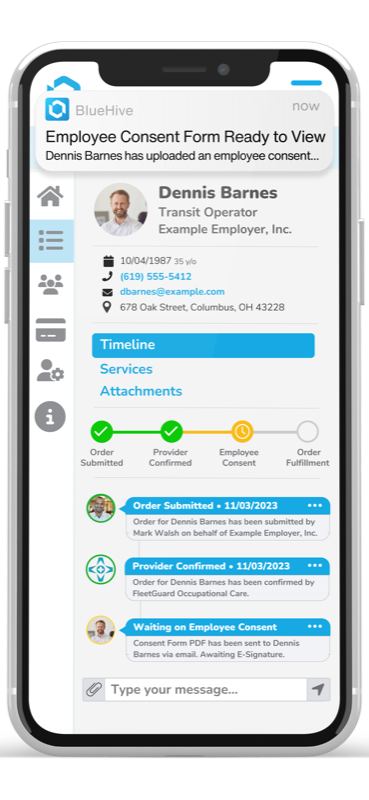
- Candidates receive clear, centralized instructions and reminders
- Employers, staffing firms, and providers share a single view of progress
This turns “We are waiting on the clinic” into a scheduled appointment and a predictable turnaround time.
Conclusion
Healthcare staffing will never be effortless. The labor market is tight, patient acuity is high, and regulatory expectations continue to grow. But staffing shortages are not only about supply. They are also about process.
Throughout this paper, we have seen that:
- Talent often leaks out of the pipeline during pre-employment health checks, background screening, and credentialing
- Fragmented systems and manual workflows quietly extend time to start
- These delays drive vacancy, overtime, agency spend, and burnout
- A smoother, more transparent onboarding experience improves candidate follow through, supports retention, and strengthens your brand
By centralizing occupational health and compliance data, connecting to a strong provider network, automating immunization and surveillance tracking, and providing real-time visibility, organizations can move from “We hope they can start next month” to “They are cleared and on the schedule for Monday.”
BlueHive is designed to make that shift possible. By bringing employers, health providers, and employees onto one shared platform, BlueHive helps:
- Reduce hidden compliance delays that drain staffing pipelines
- Give HR and staffing leaders clear visibility into candidate readiness
- Support clinicians and employees with a predictable, less frustrating process
- Lighten the documentation burden through BlueHive AI so providers can spend more time on patient care
In a world where every filled shift matters, your occupational health and compliance process can either slow you down or set you apart. Moving from short-staffed to fully supported is a process choice, and it starts with how you handle the stretch between “You are hired” and “Welcome to the team.”
Ready to see how BlueHive can transform your onboarding and compliance?
Schedule a free demo and discover how BlueHive’s centralized platform can cut delays, reduce manual work, and connect you to our nationwide network of over 22,000 providers.
Say goodbye to staffing stress and hello to faster, cleaner, fully supported hiring.