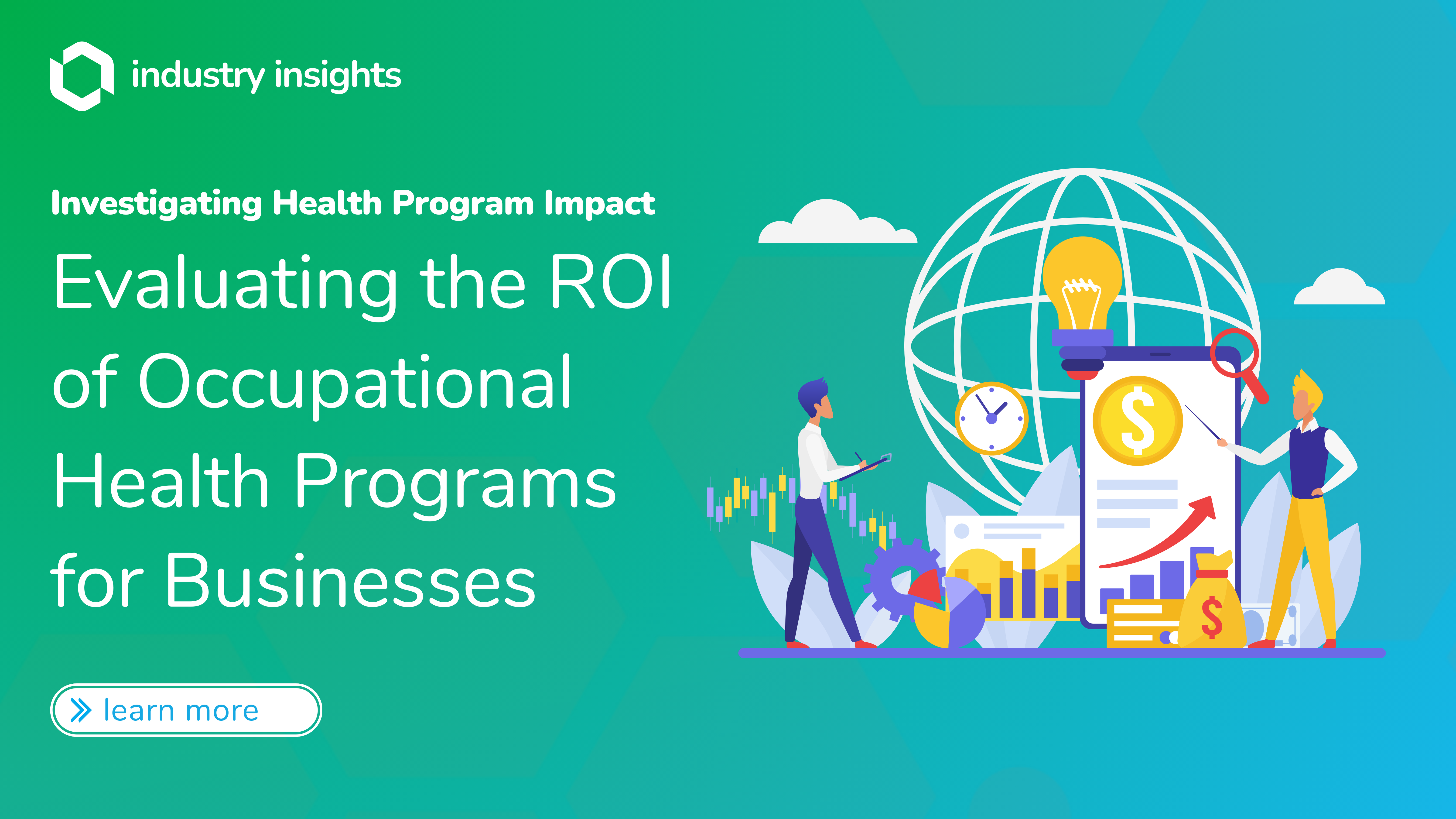
Evaluating the ROI of Occupational Health Programs for Businesses
A comprehensive framework for measuring the return on investment of occupational health programs — including formulas, benchmarks, industry data, and a timeline for when to expect results.
Introduction
Every dollar invested in occupational health should be a dollar that works — reducing costs, protecting employees, and strengthening your bottom line. Yet most organizations struggle to quantify exactly how much their programs return.
According to OSHA, businesses that invest in workplace safety and health programs see a return of $4 to $6 for every $1 spent. The challenge isn't whether occupational health programs work — it's building a measurement framework rigorous enough to prove it to your CFO.
This guide provides a comprehensive, data-driven approach to evaluating occupational health ROI — complete with formulas, benchmarks, industry comparisons, and a realistic timeline for results.
Key Takeaway
Companies with effective occupational health programs experience meaningfully lower healthcare costs, fewer lost workdays, and lower turnover compared to companies without structured programs, according to research published in the Journal of Occupational and Environmental Medicine.
Understanding the Significance of Occupational Health Programs
Occupational health programs encompass a range of initiatives designed to promote and maintain the physical, mental, and social well-being of employees within the workplace. From preventive screenings and drug testing to ergonomic assessments and mental health support, these programs protect employees while shielding organizations from regulatory risk and financial loss.
But the value goes beyond compliance. Well-run occupational health programs create a measurable competitive advantage:
- Reduced absenteeism — Healthy workers miss fewer days
- Lower workers' compensation costs — Prevention is cheaper than treatment
- Higher productivity — Presenteeism (working while unwell) can cost several times more than absenteeism
- Improved retention — Employees stay where they feel cared for
- Regulatory protection — Avoiding OSHA citations that average $16,131 per serious violation
The ROI Calculation Framework
Before diving into specific metrics, you need a reliable formula. Here's the standard approach:
The Basic ROI Formula
ROI (%) = (Total Savings − Total Program Costs) ÷ Total Program Costs × 100
Step-by-Step Calculation
Step 1: Calculate Total Program Costs Sum all costs associated with your occupational health program:
- Screening and testing fees (drug tests, physicals, hearing exams)
- Platform/software costs (e.g., BlueHive subscription)
- Administrative staff time
- Employee time away from work for screenings
- Training and education programs
- Third-party consultant fees
Step 2: Calculate Total Savings (Avoided Costs) Quantify what you didn't spend because the program existed:
- Reduction in workers' compensation claims
- Fewer lost workdays (absenteeism × average daily wage)
- Lower insurance premiums
- Avoided OSHA fines and legal costs
- Reduced turnover and replacement costs
- Productivity gains from reduced presenteeism
Step 3: Apply the Formula
Example: A 500-employee logistics company invests $150,000/year in occupational health (screenings, compliance management via BlueHive, ergonomic assessments). In the first full year, they document $87,000 in reduced workers' comp claims, $42,000 in avoided absenteeism costs, $25,000 in OSHA penalty avoidance, and $60,000 in lower turnover costs.
Total Savings: $214,000 ROI: ($214,000 − $150,000) / $150,000 × 100 = 42.7%
Pro Tip
Track your baseline metrics for at least 90 days before launching a new program. Without a baseline, you can't credibly attribute improvements to the intervention.
Key Metrics to Track
Not all metrics are created equal. Here's a framework for the most impactful measurements:
| Metric | How to Measure | Industry Benchmark | Expected Impact |
|---|---|---|---|
| Absenteeism Rate | Lost workdays ÷ total available workdays | 2.8% (BLS average) | 20–30% reduction in Year 1 |
| Workers' Comp Claims | Claims filed per 100 FTEs | Varies by industry (see below) | 15–25% reduction |
| Incident Rate (TRIR) | (Incidents × 200,000) ÷ total hours worked | 2.7 per 100 workers (BLS 2023) | 30–50% reduction over 3 years |
| Presenteeism Losses | Self-reported surveys + productivity data | Significant annual impact per employee | 10–20% recovery |
| Employee Turnover | Voluntary separations ÷ average headcount | 3.4% monthly (BLS 2023) | 10–15% reduction |
| Healthcare Costs | Per-employee per-year (PEPY) spending | $15,000+/employee (KFF employer health benefits survey) | 8–15% reduction |
| Compliance Score | Passed audits ÷ total audits | 100% target | Near-zero violations |
| Time-to-Compliance | Days from hire to fully compliant | Industry-dependent | 40–60% faster |
Absenteeism
Absenteeism is often the first metric to improve — and the easiest to measure. Track the total number of unplanned absences on a rolling monthly basis, segmented by department and cause code. According to the CDC, productivity losses from absenteeism cost U.S. employers hundreds of billions of dollars annually.
A well-designed occupational health program addresses the root causes: chronic conditions caught early through screenings, workplace injuries prevented through safety protocols, and mental health support that reduces burnout-related absences.
Workers' Compensation Claims
The National Council on Compensation Insurance (NCCI) data indicates that average workers' compensation claims cost tens of thousands of dollars when you include medical expenses, indemnity payments, and administrative costs. For serious injuries, that number climbs to $85,000+.
Track claims frequency (how often) and claims severity (how costly) separately. A program might not eliminate all claims, but shifting the mix from severe to minor injuries still produces massive ROI.
Presenteeism
The hidden giant. Presenteeism — employees showing up but performing below capacity due to health issues — is estimated to cost employers several times more than absenteeism according to workplace health research. It's harder to measure but represents the largest potential savings.
Use validated survey instruments like the Work Productivity and Activity Impairment (WPAI) questionnaire or the Stanford Presenteeism Scale to establish baselines.
Employee Turnover
Replacing an employee costs 50–200% of their annual salary (SHRM). Occupational health programs that signal "we care about your well-being" directly reduce voluntary turnover. Track resignation rates pre- and post-program launch, and segment by department to identify where health investments have the greatest retention impact.
Healthcare Costs Per Employee
Request aggregate claims data from your insurer (anonymized). Track the per-employee-per-year (PEPY) trend. Organizations with active wellness and occupational health programs see a consistent 8–15% reduction in PEPY costs within 2–3 years.
Direct vs. Indirect Costs: The Full Picture
Most organizations only measure direct costs — and miss the majority of their savings.
Direct Costs (Visible)
- Medical treatment and rehabilitation
- Workers' compensation insurance premiums
- OSHA fines and legal fees
- Disability payments
- Equipment damage from incidents
Indirect Costs (Hidden)
- Lost productivity during and after an incident
- Cost to hire and train replacements
- Overtime for coworkers covering shifts
- Administrative time for investigations and paperwork
- Decreased morale across the team
- Reputational damage affecting recruitment
The Hidden Cost Multiplier
Workplace safety research commonly cites that for every $1 in direct costs, organizations incur an estimated $2 to $5 in indirect costs, depending on the industry and incident type. If you're only tracking direct costs, you're missing the majority of the true financial impact.
When building your ROI model, apply a 2–5x multiplier to direct cost savings to estimate the full economic impact. Even a conservative 2x multiplier dramatically changes the business case.
The Cost of Inaction
What happens when organizations don't invest in occupational health? The numbers tell a stark story:
Regulatory penalties:
- OSHA serious violations: $16,131 per violation (2024 rate, adjusted annually for inflation)
- OSHA willful violations: $161,323 per violation
- Repeat violations: $161,323 per violation
- These penalties increased 45% since 2016 and continue rising
Injury costs:
- Average cost per workplace injury: $42,000 (NCCI)
- Average cost per workplace fatality: over $1 million (NSC estimates)
- Total cost of workplace injuries in the U.S.: over $160 billion annually (NSC estimates)
Turnover costs:
- Average cost to replace a frontline worker: $4,700 (SHRM)
- Average cost to replace a manager: $15,000–$25,000
- Companies with poor safety records see 2x higher turnover in operational roles
Insurance premium increases:
- A single serious claim can increase your experience modification rate (EMR) for 3 years
- Every 0.1 increase in EMR adds approximately 10% to your workers' comp premium
The question isn't "can we afford to invest in occupational health?" — it's "can we afford not to?"
Industry Benchmarking: How ROI Varies by Sector
Occupational health ROI isn't uniform across industries. Higher-risk industries see larger absolute returns, while lower-risk industries often see faster relative improvements.
| Industry | Avg. Incident Rate (per 100 workers) | Avg. Workers' Comp Cost per Claim | Typical ROI Range | Primary ROI Drivers |
|---|---|---|---|---|
| Construction | 3.2 | $52,000 | 300–500% | Injury prevention, fall protection, compliance |
| Transportation & Warehousing | 4.8 | $48,000 | 250–400% | DOT physicals, drug testing, fatigue management |
| Manufacturing | 3.3 | $39,000 | 200–350% | Ergonomics, hearing conservation, chemical exposure |
| Healthcare | 3.8 | $38,000 | 200–300% | Needlestick prevention, burnout reduction, fit testing |
| Oil & Gas | 1.8 | $65,000 | 300–500% | High severity offsets low frequency |
| Professional Services | 0.8 | $22,000 | 100–200% | Ergonomics, mental health, retention |
| Retail/Hospitality | 3.1 | $28,000 | 150–250% | Slip/fall prevention, turnover reduction |
Where to Find Your Industry Data
The Bureau of Labor Statistics (BLS) publishes annual injury and illness rates by industry through the Survey of Occupational Injuries and Illnesses (SOII). Use NAICS codes to find your exact sector benchmark.
Illustrative Example: Measuring Occupational Health Impact
Consider a mid-size transportation company with approximately 500 employees operating across multiple locations. This composite example illustrates typical outcomes based on patterns observed across organizations implementing centralized occupational health programs. Before implementing a centralized occupational health program, they faced:
- 12.4% annual turnover in driver roles (industry average: 9.5%)
- 47 workers' comp claims per year
- $680,000 in annual workers' comp costs
- 3 OSHA citations in the prior 2 years totaling $38,000 in fines
- Average 6.2 days from hire to DOT physical completion (delaying revenue)
After implementing a structured program with BlueHive:
| Metric | Before | After (Year 1) | Change |
|---|---|---|---|
| Annual turnover (drivers) | 12.4% | 8.7% | -30% |
| Workers' comp claims | 47 | 31 | -34% |
| Workers' comp costs | $680,000 | $465,000 | -$215,000 |
| OSHA citations | 3 | 0 | -100% |
| Time to DOT compliance | 6.2 days | 1.8 days | -71% |
| Annual program investment | — | $180,000 | — |
Year 1 ROI Calculation:
- Workers' comp savings: $215,000
- OSHA penalty avoidance (estimated): $32,000
- Turnover savings (18.5 fewer separations × $4,700): $87,000
- Faster onboarding revenue (4.4 days × 500 hires × $180/day): $396,000
- Total quantified savings: $730,000
- Program cost: $180,000
- ROI: 306%
Timeline to ROI: When to Expect Results
One of the biggest mistakes is expecting immediate payoff. Occupational health ROI follows a predictable curve:
Quick Wins (First 90 Days)
- Compliance gaps closed — Identify and remediate outstanding violations
- Administrative time saved — Centralized scheduling and tracking via BlueHive eliminates manual spreadsheet management
- Faster onboarding — New hires cleared for work in days instead of weeks
- Baseline established — You now have data to measure against
Medium-Term Gains (6–12 Months)
- Absenteeism drops — As preventive screenings catch issues early
- Claims frequency declines — Training and awareness programs take effect
- Insurance premiums stabilize — Fewer claims slow the EMR increase
- Employee satisfaction improves — Survey scores begin reflecting the investment
Long-Term Transformation (1–3 Years)
- Workers' comp premiums decrease — EMR improvements flow through to premiums (typically with a 1-year lag)
- Turnover rates drop significantly — Culture of health becomes a retention driver
- Healthcare cost per employee declines — Chronic condition management and prevention compound
- Regulatory track record strengthens — Zero-citation streak becomes a competitive differentiator
Set Expectations
Most organizations see positive ROI within 12–18 months. The compounding effect means Year 3 returns are typically 2–3x greater than Year 1. Communicate this trajectory to leadership upfront to maintain program support through the investment phase.
Common Pitfalls When Measuring ROI
Even well-intentioned measurement efforts can produce misleading results. Avoid these mistakes:
1. Not Establishing a Baseline
You can't measure improvement without a starting point. Collect at least 90 days of pre-intervention data on absenteeism, claims, and compliance metrics before launching.
2. Only Tracking Direct Costs
If your ROI model only includes workers' comp payouts and medical bills, you're missing the majority of the picture. Include indirect costs (productivity losses, turnover, morale) using the indirect cost multiplier.
3. Ignoring Presenteeism
Employees who show up sick or in pain cost more than those who stay home. Presenteeism is the single largest occupational health cost — and it's invisible unless you deliberately measure it.
4. Attributing All Improvement to One Program
Correlation isn't causation. If you launched a new occupational health platform, changed insurance providers, and restructured HR in the same quarter, you can't credit all improvement to one intervention. Use control groups or staggered rollouts when possible.
5. Using Annual Snapshots Instead of Trends
A single year's data includes noise — seasonal patterns, one-off incidents, economic cycles. Track rolling 12-month trends and look for sustained directional improvement over 2–3 years.
6. Forgetting to Account for Program Maturation
A new program's Year 1 ROI will always be lower than Year 3. If you evaluate solely on first-year results, you'll undervalue programs that compound over time.
7. Not Communicating Results to Stakeholders
The best ROI analysis is worthless if leadership doesn't see it. Build a quarterly dashboard showing key metrics, trends, and projected savings. Make the business case continuously, not just at budget time.
BlueHive's Role in Maximizing Occupational Health ROI
BlueHive serves as the operational backbone that makes measurement — and improvement — possible. Here's how the platform directly influences each ROI lever:
Centralized data for accurate measurement. BlueHive aggregates employee health records, screening results, compliance status, and scheduling data in one platform. No more spreadsheets, no more data silos, no more guessing.
Automated compliance tracking. The platform monitors certification expirations, required screenings, and regulatory deadlines automatically — sending alerts before gaps become violations. This directly reduces OSHA citation risk and the administrative burden of manual tracking.
Faster time-to-compliance. BlueHive's provider network and digital scheduling reduce the time from hire to fully compliant status by 50–70%. For industries where employees can't work until cleared, this translates directly to revenue.
Real-time dashboards. Track claims, compliance rates, screening completion, and spending in real-time. No more waiting for quarterly reports to discover problems.
Streamlined invoicing and cost visibility. Consolidated billing across all providers means you always know exactly what you're spending — by location, department, or service type.
Build Your ROI Case: A Practical Checklist
Ready to evaluate your own program's ROI? Use this checklist:
- Establish baselines — Collect 90+ days of pre-intervention data on key metrics
- Identify all cost categories — Direct and indirect (use the 2–5x indirect cost multiplier)
- Set measurement intervals — Monthly tracking, quarterly reporting, annual deep-dive
- Choose 3–5 primary KPIs — Don't try to measure everything; focus on what matters for your industry
- Build a comparison framework — Year-over-year, industry benchmarks, or pre/post program launch
- Document avoided costs — OSHA fines not received, claims not filed, employees not lost
- Calculate and report ROI quarterly — Keep leadership informed and invested
- Adjust the program based on data — Double down on what works, fix what doesn't
Conclusion: From Cost Center to Competitive Advantage
Occupational health programs aren't an expense to minimize — they're an investment to optimize. The organizations that treat them this way consistently outperform on safety, retention, regulatory compliance, and total cost of risk.
The data is clear: every $1 invested returns $4–$6 when programs are well-designed and properly managed. The key is building the measurement infrastructure to prove it — and using a platform like BlueHive to collect, analyze, and act on the data in real-time.
Your next steps:
- Audit your current state — What are you spending? What are you measuring? What's missing?
- Establish baselines — You can't improve what you don't track
- Implement centralized management — Platforms like BlueHive eliminate the manual overhead that buries ROI
- Report results quarterly — Turn occupational health from a compliance obligation into a strategic asset
- Try our free scorecard — Take the BlueHive Compliance Scorecard to identify your biggest opportunities for improvement
Ready to See Your ROI?
BlueHive helps hundreds of organizations measure and maximize their occupational health ROI. Schedule a demo to see how the platform can work for your team, or try our compliance scorecard to benchmark your current program.
Stay Current on OSHA & Workplace Safety
State regulations change frequently. Track the latest updates in our Compliance Watch.
View OSHA & Workplace Safety Updates
Director Of Marketing
30 articles
Evelyna Bellamy leads marketing at BlueHive, driving brand strategy and thought leadership in the occupational health space.
Related Services
Related Articles
Ready to streamline your occupational health program?
BlueHive connects you to 20,000+ clinics nationwide with real-time scheduling and results.