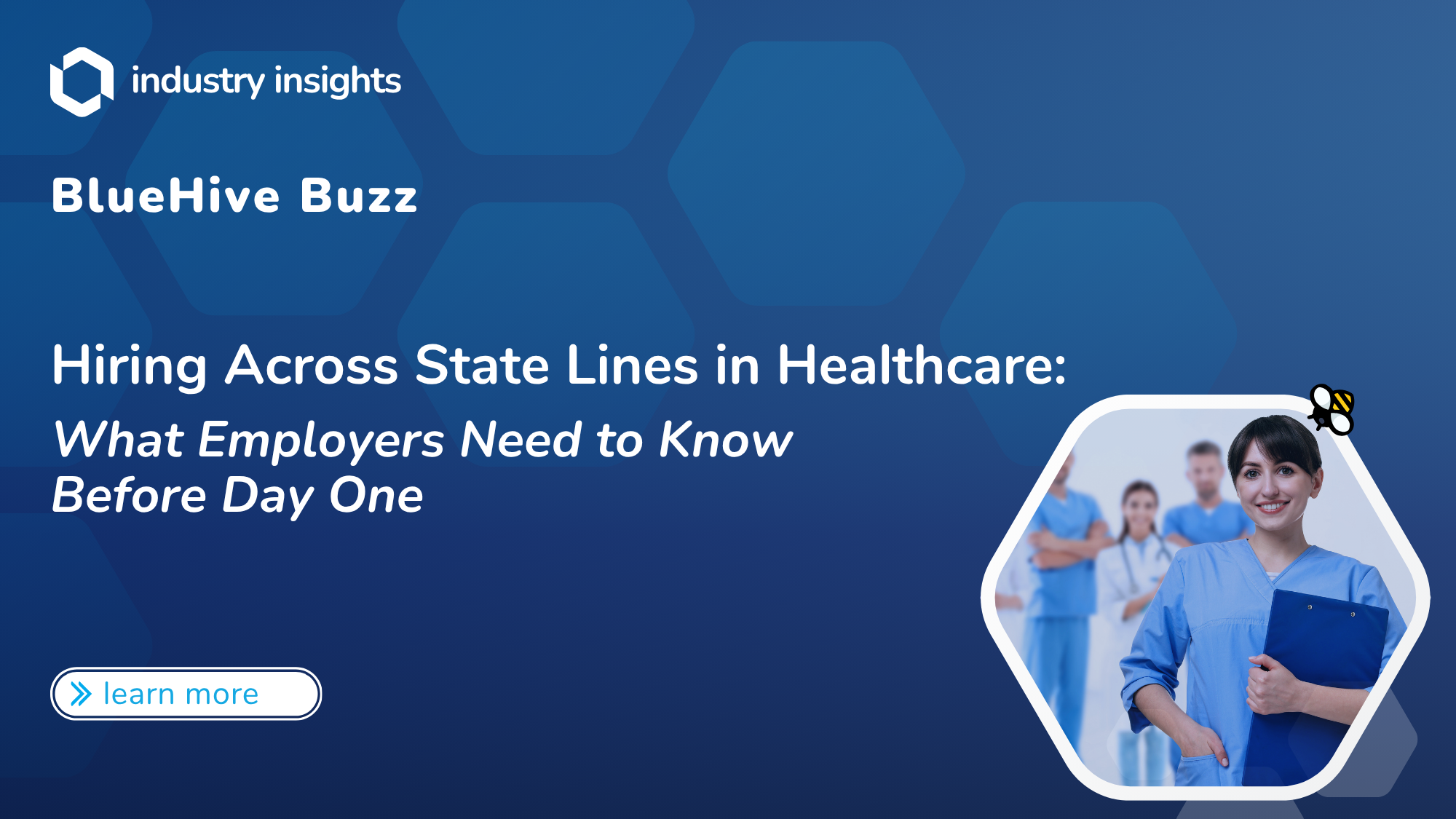
Hiring Across State Lines in Healthcare: What Employers Need to Know Before Day One
Executive Summary
Multi-state healthcare hiring is complicated by role-specific requirements, state-level differences in screening timelines, and fragmented onboarding workflows. This whitepaper explores where delays happen and how a more coordinated approach can help.
Hiring in healthcare is rarely simple. Between screenings, credentialing, occupational health requirements, and role-specific compliance steps, even a single-state hiring process can be difficult to manage. Add multiple states to the mix, and the process can get complicated very quickly (CDC, n.d.-a); (CDC, 2026); (Joint Commission, 2022); (SAMHSA, 2026).
For healthcare employers, the stakes are high from the start. Open roles can affect patient care, staff burnout, scheduling stability, and revenue. At the same time, hiring teams cannot afford to rush past important onboarding requirements. Drug screening, background checks, license verification, exclusion checks, immunization records, and role-based medical clearances all need to come together before a candidate is fully ready to begin (CMS, n.d.); (CDC, 2011); (CDC, n.d.-a); (CDC, 2026); (FSMB, n.d.); (NCSBN, n.d.-b); (OIG, n.d.-a); (OIG, n.d.-b); (SAMHSA, 2026).
That challenge becomes even greater when hiring happens across state lines. A process that works smoothly in one location may need adjustments in another. The result is often more manual follow-up, more coordination between teams, and more opportunities for delays that push out start dates (NCSL, n.d.); (NCSL, 2022); (NELP, 2021); (NGA, n.d.); (NCSBN, n.d.-a).
This whitepaper explores why multi-state healthcare hiring can be so difficult, where employers tend to get stuck, and how a more coordinated approach can help streamline the journey from offer acceptance to day one.
Multi-state Healthcare Hiring Gets Complicated
Healthcare employers often aim for consistency. That makes sense. Standardized hiring processes are easier to manage, easier to scale, and easier to train across teams. But healthcare hiring does not always reward a one-size-fits-all approach.
Some hiring requirements are shaped by role. Others are shaped by care setting. Others still are influenced by state-level differences that affect how and when screenings happen (CMS, n.d.); (NCSL, 2022); (NGA, n.d.).
For example, an employer may use a standard pre-employment screening process for clinical hires, but that process may need to flex depending on the location and position. A hospital-based role may involve fingerprinting, exclusion checks, immunization tracking, and license verification. A home health role may add driving record considerations. A long-term care setting may involve a different screening sequence or documentation workflow. Even when the broad hiring goal is the same, the execution can look different (CDC, 2011); (CDC, n.d.-a); (CMS, n.d.); (FSMB, n.d.); (NCSBN, n.d.-a); (NCSBN, n.d.-b); (OIG, n.d.-a); (OIG, n.d.-b).
Cannabis-related employment considerations add another layer of complexity. State approaches continue to vary, especially around testing practices, off-duty use, and safety-sensitive roles. Background screening timing can also differ. In some places, there may be limits on when criminal history can be considered in the hiring process. In others, the path is more flexible. Healthcare organizations hiring across multiple jurisdictions often have to navigate these differences while still trying to move quickly (NCSL, n.d.); (NELP, 2021).
That is where many teams run into trouble. The hiring program may be designed at a high level, but the details that determine whether a candidate clears onboarding are often local, role-specific, and time-sensitive (NCSL, 2022); (NGA, n.d.); (NELP, 2021).
Common Hiring Requirements Healthcare Employers Need to Track
Healthcare hiring usually requires more than a basic offer letter and a background check. Most employers are managing a collection of pre-start steps that need to be completed, documented, and sometimes repeated based on state, role, or facility expectations.
Pre-employment drug screening is one of the most common components. For some organizations, it is a standard part of onboarding across nearly all roles. For others, the testing approach varies depending on state law, risk level, or whether the role is considered safety-sensitive. Even when the screening itself is straightforward, delays can happen if scheduling, collection, review, or follow-up is not coordinated well (NCSL, n.d.); (SAMHSA, 2026).
Criminal background checks are another central piece. In healthcare, these checks are often only the starting point. Depending on the position, employers may also need fingerprint-based screening, abuse registry checks, or other setting-specific reviews. Timing matters here. If the screening process is started too late, it can hold up an otherwise ready-to-start candidate (CMS, n.d.); (NELP, 2021).
Professional license verification is equally important. Healthcare employers need confidence that licenses are active, in good standing, and appropriate for the role being filled. That may sound simple, but it becomes more complicated when hiring at scale or across multiple states, especially for organizations managing a mix of clinicians, support staff, and allied health professionals (FSMB, n.d.); (NCSBN, n.d.-a); (NCSBN, n.d.-b); (NGA, n.d.).
Exclusion checks can also play a major role. Many healthcare employers need to verify that candidates are not listed on federal exclusion databases before they begin work in roles connected to federally funded programs. Missing this step is not just an administrative oversight. It can create serious compliance issues (OIG, n.d.-a); (OIG, n.d.-b); (OIG, n.d.-c); (U.S. Department of the Interior, n.d.).
Occupational health requirements round out the picture. Depending on the role and employer, this may include TB screening, immunization documentation, respirator clearance, fit testing, or other medical evaluations. These steps are essential, but they can also slow hiring if they are handled in separate systems or scheduled without visibility into the rest of the onboarding timeline (CDC, 2011); (CDC, n.d.-a); (CDC, 2026).
Each one of these requirements matters on its own. Together, they form a process that can either move efficiently or become a maze of disconnected tasks.
Where Delays Usually Happen
Most healthcare hiring delays do not happen because one requirement is unusually difficult. They happen because too many requirements are managed in too many places.
A candidate may complete a drug screen, but their occupational health appointment is still pending. A background check may be underway, but license verification has not started. Immunization records may have been requested, but no one knows whether they were received. HR may believe onboarding is on track while the hiring manager is still waiting for one missing clearance (CDC, 2011); (CDC, n.d.-a); (CDC, 2026); (CMS, n.d.); (FSMB, n.d.); (NCSBN, n.d.-b); (SAMHSA, 2026).
This is where the friction builds.
In many organizations, background screening, occupational health, and credentialing are handled by different teams or vendors. That can create gaps in visibility and slow communication between the people who need to move the candidate forward. A delay of one or two days in one step can ripple through the rest of the process (CDC, 2026); (CMS, n.d.); (Joint Commission, 2022).
Out-of-state hires often create even more complexity. A candidate may be ready, motivated, and available, but the process stalls because an appointment is not easy to schedule, a record is still being reviewed, or a site-specific requirement was not flagged early enough (NGA, n.d.); (NCSL, 2022); (NCSBN, n.d.-a).
Healthcare teams feel these delays immediately. Open shifts stay open. Managers follow up repeatedly. HR teams spend time tracking down status updates instead of focusing on the broader hiring pipeline. Candidates get frustrated. In competitive hiring markets, some simply move on.
Hiring a nurse, technician, therapist, or support team member should not feel like assembling a thousand-piece puzzle while someone quietly hides the corner pieces.
Why a One-Size-Fits-All Hiring Program Falls Short
The answer to this problem is not to make every location create its own process from scratch. That usually creates even more inconsistency.
What healthcare employers need is a coordinated hiring framework that keeps the core process standardized while allowing for role-based and state-aware adjustments where needed.
That means having a consistent baseline for what happens after a candidate accepts an offer. It also means knowing where flexibility is required. One role may need a straightforward screen and verification process. Another may need a more complex sequence involving occupational health, credentialing, exclusion checks, and additional documentation. One state may allow a broader approach to testing. Another may require a more careful workflow (CDC, 2011); (CDC, n.d.-a); (CDC, 2026); (CMS, n.d.); (FSMB, n.d.); (NCSL, n.d.); (NCSL, 2022); (NCSBN, n.d.-b); (OIG, n.d.-a); (OIG, n.d.-b); (SAMHSA, 2026).
The goal is not perfection through complexity — it's clarity through coordination.
When employers can standardize the core workflow, identify where state-level differences matter, and keep everyone aligned around candidate status, the hiring process becomes much easier to manage. Teams spend less time chasing paperwork and more time moving people into roles.
How BlueHive Helps Simplify the Process
BlueHive helps healthcare employers coordinate the hiring and onboarding steps that often create the most friction. Instead of managing screenings and occupational health requirements through fragmented workflows, employers can move toward a more centralized process that supports faster decisions and fewer delays.
With access to a nationwide provider network, BlueHive makes it easier to schedule and complete required services across locations. That matters for healthcare employers hiring in multiple states, especially when consistency and turnaround time both affect workforce readiness.
BlueHive can support common hiring needs such as drug screening, occupational health services, and related onboarding workflows, helping employers reduce the administrative burden that comes from juggling too many disconnected tasks. For HR teams, that means better visibility. For candidates, that means a smoother experience. For employers, that means a more reliable path from accepted offer to cleared start date.
In healthcare, every day counts. A more coordinated hiring process does not just save time. It helps teams fill roles faster, reduce internal friction, and support a better experience for the people joining the organization.
Conclusion
Multi-state healthcare hiring requires more than a checklist. It requires a process that can keep pace with urgent staffing needs while still supporting the screenings, verifications, and health requirements that matter before day one.
When hiring workflows are fragmented, even small delays can create larger operational problems. But when employers take a more coordinated approach, they can reduce administrative burden, improve visibility across the onboarding process, and help candidates move through required steps more efficiently.
For healthcare organizations hiring across state lines, consistency matters. So does flexibility. The most effective hiring programs are not rigid. They are organized, scalable, and able to adapt when location, role, or care setting changes the path to readiness (CDC, 2026); (Joint Commission, 2022); (NCSL, 2022); (NGA, n.d.).
That is where better coordination can have a real impact.
Explore State-by-State Healthcare Hiring Requirements
Need the state-by-state view? Use BlueHive's Nation-Wide Hiring Guide to explore hiring requirements by state and industry, including common screens, certifications, and onboarding considerations for healthcare employers.
Sources
- Centers for Disease Control and Prevention. (n.d.-a). Clinical testing guidance for tuberculosis: Health care personnel. https://www.cdc.gov/tb-healthcare-settings/hcp/screening-testing/index.html
- Centers for Disease Control and Prevention. (2011). Immunization of healthcare personnel: Recommendations of the Advisory Committee on Immunization Practices (ACIP). https://www.cdc.gov/porthealth/media/pdfs/CDCs-vaccine-recommendations-for-healthcare-personnel.pdf
- Centers for Disease Control and Prevention. (2026, March 10). Clinical safety: Occupationally-acquired infections and healthcare workers. https://www.cdc.gov/infection-control/hcp/safety/index.html
- Centers for Medicare & Medicaid Services. (n.d.). CMS National Background Check Program. https://www.cms.gov/medicare/enrollment-renewal/providers-suppliers/national-background-check
- Federation of State Medical Boards. (n.d.). Federation Credentials Verification Service. https://www.fsmb.org/fcvs/
- Joint Commission. (2022, February 8). What initial job training and information needs to be provided at orientation? https://www.jointcommission.org/en-us/knowledge-library/support-center/standards-interpretation/standards-faqs/000001435
- National Conference of State Legislatures. (n.d.). Cannabis and employment: Medical and recreational policies in the states. https://www.ncsl.org/health/cannabis-and-employment-medical-and-recreational-policies-in-the-states
- National Conference of State Legislatures. (2022, August 12). The National Occupational Licensing Database. https://www.ncsl.org/labor-and-employment/the-national-occupational-licensing-database
- National Council of State Boards of Nursing. (n.d.-a). Licensure compacts. https://www.ncsbn.org/compacts.page
- National Employment Law Project. (2021, October 1). Ban the box: U.S. cities, counties, and states adopt fair hiring policies. https://www.nelp.org/insights-research/ban-the-box-fair-chance-hiring-state-and-local-guide/
- National Governors Association. (n.d.). Licensing and regulation. https://www.nga.org/state-health-workforce-toolkit/licensing-and-regulation/
- Office of Inspector General, U.S. Department of Health and Human Services. (n.d.-a). Exclusions program. https://oig.hhs.gov/exclusions/
- Office of Inspector General, U.S. Department of Health and Human Services. (n.d.-b). Background information. https://www.oig.hhs.gov/exclusions/background.asp
- Office of Inspector General, U.S. Department of Health and Human Services. (n.d.-c). Authorities | Exclusions. https://oig.hhs.gov/exclusions/effects_of_exclusion.asp
- Substance Abuse and Mental Health Services Administration. (2026, February 23). Workplace drug testing resources. https://www.samhsa.gov/substance-use/drug-free-workplace/drug-testing-resources
- U.S. Department of the Interior. (n.d.). How to search for exclusions on SAM.gov. https://www.doi.gov/pam/suspension-debarment/search-exclusions
Stay Current on OSHA & Workplace Safety
State regulations change frequently. Track the latest updates in our Compliance Watch.
View OSHA & Workplace Safety Updates
Content Developer
71 articles
Chris Davis is a content developer at BlueHive, covering occupational health compliance, workplace safety, and industry best practices.
Related Services
Related White Papers
 White Paper
State-by-State TB & Immunization Requirements for Travel Nurses (2026)
Chris Davis·18 min read White Paper
Your Hiring Process is a Candidate Experience: How Occupational Health Steps Can Build Trust
Chris Davis·44 min read White Paper
The Hidden Costs of "Good Enough" - Part 2
Chris Davis·14 min readReady to streamline your occupational health program?
BlueHive connects you to 20,000+ clinics nationwide with real-time scheduling and results.