Managing Drug Testing and Health Screenings Across the Transportation Sector
With ~4 million DOT drug tests conducted annually and positivity rates climbing to 5.1%, transportation employers face mounting compliance pressure. Non-compliance penalties average $16,000 per violation — here is how to build a bulletproof program.
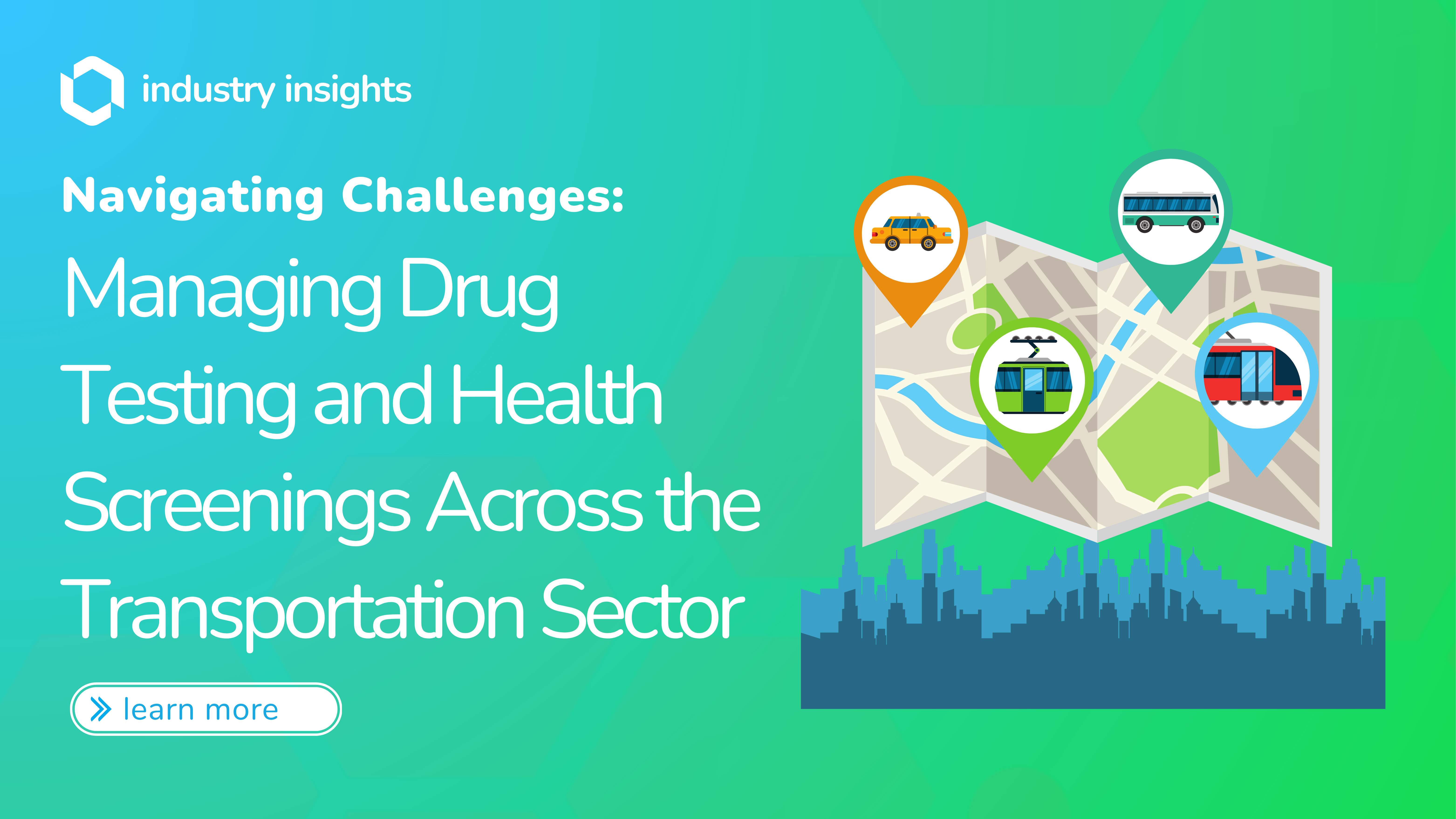
The transportation sector runs on compliance. With approximately 4 million DOT drug tests conducted annually and the Quest Diagnostics Drug Testing Index reporting that positivity rates in the general U.S. workforce have climbed steadily in recent years, reaching multi-decade highs — HR and compliance professionals are facing a rapidly shifting landscape.
The stakes could not be higher. Drug- and alcohol-related impairment remains a significant factor in commercial vehicle crashes, representing billions of dollars in economic costs annually according to NHTSA and FMCSA research. Meanwhile, FMCSA random testing rates remain at 50% for drugs and 10% for alcohol, and a single FMCSA non-compliance violation can carry penalties of $16,000 or more. For fleets with hundreds of drivers, a compliance gap is not just a regulatory risk — it is a financial one.
This guide breaks down every requirement you need to know, the common traps that catch even experienced compliance managers, and how to build a program that protects your organization, your drivers, and the public.
Understanding the DOT Drug Testing Framework
The Department of Transportation's drug and alcohol testing program, governed by 49 CFR Part 40, applies to all safety-sensitive employees across six DOT agencies — including FMCSA (trucking), FAA (aviation), FRA (rail), FTA (transit), PHMSA (pipelines), and USCG (maritime). For the transportation sector, FMCSA regulations under 49 CFR Part 382 establish the specific requirements motor carriers must follow.
There are six distinct categories of DOT drug testing, each with its own triggers, timelines, and common failure points.
The 6 DOT Drug Testing Categories
| Testing Category | When Required | Key Requirements | Common Pitfalls |
|---|---|---|---|
| Pre-Employment | Before performing any safety-sensitive function | Must receive verified negative result before driver operates a CMV | Allowing drivers to start work before results are verified |
| Random | Ongoing, throughout employment | 50% of average driver pool annually for drugs; 10% for alcohol | Failing to use a scientifically valid random selection method |
| Post-Accident | After DOT-reportable accidents | Drug test within 32 hours; alcohol test within 8 hours (2 hours preferred) | Missing the testing window, especially for alcohol |
| Reasonable Suspicion | When trained supervisor observes signs of use | Requires observation by a supervisor trained in reasonable suspicion indicators | Untrained supervisors making the determination |
| Return-to-Duty | Before returning after a violation | Must complete SAP evaluation and treatment; directly observed collection required | Allowing return before SAP process is fully completed |
| Follow-Up | After returning to duty | Minimum 6 tests in first 12 months; can extend up to 60 months | Not maintaining the required frequency or duration |
Post-Accident Testing Windows Are Non-Negotiable
If you miss the 32-hour drug testing window or the 8-hour alcohol testing window after a DOT-reportable accident, the test is void. Document exactly why the test was not conducted within the required timeframe. Failure to test — or failure to document why testing did not occur — is treated as a violation by FMCSA auditors.
The DOT 5-Panel vs. Extended Testing Panels
DOT mandates a specific 5-panel urine drug test. However, many employers also run expanded panels for non-DOT positions or as part of company policy. Understanding the distinction is critical.
Standard DOT 5-Panel vs. Extended Panels
| Substance | DOT 5-Panel (Required) | Extended 10-Panel (Optional) | Detection Window (Urine) |
|---|---|---|---|
| Marijuana (THC) | Yes | Yes | 3-30 days |
| Cocaine | Yes | Yes | 2-4 days |
| Amphetamines/Methamphetamine | Yes | Yes | 2-4 days |
| Opioids (codeine, heroin, morphine, hydrocodone, hydromorphone, oxycodone, oxymorphone) | Yes | Yes | 2-4 days |
| Phencyclidine (PCP) | Yes | Yes | 7-14 days |
| Benzodiazepines | No | Yes | 3-7 days |
| Barbiturates | No | Yes | 2-10 days |
| Methadone | No | Yes | 3-5 days |
| Propoxyphene | No | Yes | 1-2 days |
| MDMA (Ecstasy) | No | Yes | 2-4 days |
Note that the DOT expanded its opioid panel effective January 1, 2018 to include hydrocodone, hydromorphone, oxycodone, and oxymorphone — reflecting the ongoing opioid crisis. All DOT-regulated tests must use urine specimens collected under strict chain-of-custody procedures and analyzed by SAMHSA-certified laboratories.
The Hair Follicle Testing Debate
Hair follicle testing has been a topic of significant discussion in the transportation industry. While it offers a 90-day detection window compared to urine's typical 3-5 day window, its DOT acceptance remains limited.
Current status: FMCSA published a Notice of Proposed Rulemaking (NPRM) that would allow hair testing as an alternative to urine for pre-employment and random testing. However, as of 2025, hair testing is not yet approved as a DOT-compliant method. Some carriers use it as a supplemental, non-DOT test within company policy.
Pros of hair testing:
- 90-day detection window catches habitual users
- Extremely difficult to adulterate or substitute
- Lower specimen collection error rates
Cons:
- Not yet DOT-approved for regulated testing
- Higher per-test cost ($100-150 vs. $30-60 for urine)
- Concerns about potential racial bias in detection rates
- Cannot detect very recent use (first 7-10 days)
State Marijuana Laws Do Not Override Federal DOT Requirements
Regardless of state marijuana legalization — whether medical or recreational — DOT-regulated employees are prohibited from using marijuana in any form. A positive THC result on a DOT drug test is a violation, period. This creates a challenging communication burden for HR teams, especially in states where recreational use is legal. Make sure your drug-free workplace policy explicitly addresses this conflict and that new hires understand the federal requirement during onboarding.
DOT Clearinghouse: The Compliance Game-Changer
The FMCSA Drug and Alcohol Clearinghouse, which became mandatory on January 6, 2020, fundamentally changed how carriers manage driver compliance. It is a centralized, secure database that tracks all DOT drug and alcohol violations for CDL holders.
Query Requirements
- Full Query: Required before hiring any CDL driver. Provides complete violation history. Requires driver consent (electronic consent through the Clearinghouse). Must be conducted annually for all current drivers.
- Limited Query: Can be run without individual driver consent but requires blanket consent. Shows only whether a record exists — not the details. Commonly used for annual checks if the driver has provided blanket consent for limited queries.
Reporting Requirements
The following must be reported to the Clearinghouse:
- Positive drug or alcohol test results (reported by Medical Review Officers)
- Refusals to test (reported by employers)
- Actual knowledge violations (reported by employers)
- SAP reporting of return-to-duty completion (reported by SAPs)
- Negative return-to-duty test results (reported by employers)
Annual Clearinghouse Queries Are Not Optional
Starting November 18, 2024, carriers must conduct annual full queries on all CDL drivers — limited queries no longer satisfy the annual requirement. Failure to run these queries can result in violations during FMCSA audits, with penalties up to $16,000 per occurrence. If you have 200 drivers and skip annual queries, your potential exposure is $3.2 million.
Health Screening Requirements for Transportation Workers
Drug testing is only half the compliance equation. DOT physical examinations — formally known as FMCSA medical examinations — determine whether a driver is physically qualified to operate a commercial motor vehicle.
DOT Physical Components and Requirements
| Examination Component | Requirement | Disqualifying Conditions | Waiver/Exemption Available? |
|---|---|---|---|
| Vision | 20/40 acuity in each eye (with or without correction); 70-degree field of vision | Monocular vision (Federal Vision Exemption available) | Yes — Federal Vision Exemption Program |
| Hearing | Perceive forced whisper at 5 feet OR audiometric test showing adequate hearing | Complete deafness in both ears without hearing aid correction | Yes — Hearing Exemption Program |
| Blood Pressure | Stage 1 (140-159/90-99): 1-year cert; Stage 2 (160-179/100-109): 1-year cert with treatment; Stage 3 (180+/110+): disqualified | Stage 3 hypertension; uncontrolled Stage 2 | Temporary — with treatment documentation |
| Diabetes | Stable blood sugar; no insulin use (without exemption) | Insulin-treated diabetes (without exemption) | Yes — Federal Diabetes Exemption |
| Cardiovascular | No current diagnosis of MI, angina, coronary insufficiency, or cardiovascular disease likely to cause syncope | History of heart attack (within specific timeframes), implanted cardiac defibrillator | Case-by-case with specialist documentation |
| Respiratory | No established diagnosis of respiratory dysfunction likely to interfere with safe driving | Severe COPD, uncontrolled asthma requiring emergency treatment | Case-by-case |
| Neurological | No seizure disorder, no epilepsy diagnosis | Epilepsy, any seizure within past 8 years (without exemption) | Yes — Federal Seizure Exemption Program |
| Musculoskeletal | No impairment that interferes with safe vehicle operation | Loss of limb or limb function without adequate adaptive equipment | Skill Performance Evaluation (SPE) certificate |
Sleep Apnea Screening: Navigating the Gray Area
Sleep apnea screening remains one of the most contentious areas in transportation health compliance. While FMCSA has not issued a formal rule mandating sleep apnea testing, many medical examiners on the National Registry of Certified Medical Examiners (NRCME) screen for it based on clinical guidelines.
What you need to know:
- There is no federal mandate requiring all drivers to be tested for sleep apnea
- Medical examiners can require a sleep study based on clinical judgment (BMI over 35, neck circumference over 17 inches, observed symptoms)
- If diagnosed, drivers must demonstrate effective treatment (typically CPAP compliance of 4+ hours per night for 70%+ of nights)
- Untreated moderate-to-severe sleep apnea can result in a conditional or denied medical certificate
- Treatment compliance data must be available for the medical examiner at each recertification
For carriers, the practical implication is clear: build sleep apnea screening into your onboarding and annual health review process, even if it is not technically required. The liability exposure from an untreated driver involved in a fatigue-related crash far outweighs the screening cost.
The Compliance Cost-Benefit Equation
Many carriers view drug testing and health screening programs as pure cost centers. The data tells a different story.
Compliance Program Costs vs. Non-Compliance Exposure
| Category | Annual Cost (Compliance) | Cost of Non-Compliance/Incident |
|---|---|---|
| Drug testing program (100 drivers) | $15,000-25,000 | $16,000 per FMCSA violation |
| DOT physicals (100 drivers) | $10,000-15,000 | $75,000+ per unqualified driver accident claim |
| Clearinghouse queries (100 drivers) | $150-250 (queries) + admin time | $16,000 per missed query violation |
| Random testing management | $5,000-8,000 | $16,000 per program deficiency |
| SAP and return-to-duty costs (per case) | $3,000-5,000 per driver | $100,000+ in litigation if process not followed |
| Total annual program cost | $30,000-50,000 | Single serious accident: $500K-$5M+ |
The math is unambiguous. A comprehensive compliance program for 100 drivers costs roughly what a single FMCSA violation costs — and it is a fraction of the exposure from a single at-fault accident involving a non-compliant driver.
Every $1 Spent on Compliance Returns $3-5 in Avoided Risk
Research from the National Safety Council and industry studies suggests that employers with comprehensive drug-free workplace programs experience meaningfully fewer accident claims and workers' compensation filings, along with lower insurance premiums. For transportation companies specifically, strong compliance records can reduce insurance costs by 15-25% annually.
Multi-State Compliance Challenges
Operating across state lines introduces a layer of complexity that single-state carriers do not face. While DOT regulations are federal and apply uniformly, several state-level factors create compliance headaches.
Key challenges include:
- State marijuana laws: As of 2025, 24 states plus D.C. have legalized recreational marijuana. Your drug-free workplace policy must clearly state that federal DOT requirements override state law for safety-sensitive employees.
- State drug testing regulations: Some states (like California and Vermont) have additional employee protections around drug testing procedures, notification requirements, and confirmatory testing.
- Medical examiner availability: Rural corridors often lack NRCME-certified medical examiners, forcing drivers to travel significant distances for DOT physicals.
- Varying collection site quality: Not all collection sites follow DOT protocols consistently. Using a vetted, nationwide network eliminates this variability.
- Recordkeeping requirements: Some states impose additional retention requirements beyond the federal standard.
Managing the SAP and Return-to-Duty Process
When a driver tests positive or refuses a test, the Substance Abuse Professional (SAP) process kicks in. This is one of the most frequently mismanaged areas of DOT compliance.
The SAP Process, Step by Step
- Removal from safety-sensitive duty — immediately upon receiving a verified positive or refusal
- SAP referral — employer must provide the driver with a list of qualified SAPs (the employer does NOT choose the SAP — the driver selects one)
- Initial SAP evaluation — SAP determines treatment and/or education requirements
- Driver completes prescribed treatment — can range from education programs to inpatient rehabilitation
- Follow-up SAP evaluation — SAP determines if the driver has complied with recommendations
- Return-to-duty test — directly observed collection; must be negative to return
- Follow-up testing plan — minimum 6 unannounced tests in the first 12 months; can extend up to 60 months at SAP discretion
MRO Requirements: Do Not Skip This Step
Every DOT drug test must be reviewed by a qualified Medical Review Officer (MRO) — a licensed physician with specialized knowledge of substance abuse. The MRO interviews the donor to determine if there is a legitimate medical explanation for a positive result before reporting it as verified positive. Using an MRO who is not properly qualified, or bypassing MRO review entirely, invalidates the test and creates a compliance gap. Verify your MRO credentials annually.
Illustrative Example: How a Regional Carrier Centralized Compliance
Company profile (composite): A mid-size LTL carrier operating approximately 540 drivers across 14 states in the Southeast and Midwest. This illustrative example represents typical outcomes based on patterns observed across transportation companies implementing centralized compliance programs.
The problem: Before centralizing their compliance program, Regional Freight managed drug testing and health screenings through a patchwork of 38 different local clinics with no consistent scheduling, pricing, or result-reporting process. Their compliance manager spent an estimated 25 hours per week chasing results and managing scheduling across locations.
Before and After Metrics
| Metric | Before (Decentralized) | After (Centralized via BlueHive) | Improvement |
|---|---|---|---|
| Average time to receive drug test results | 5.2 business days | 1.8 business days | 65% faster |
| DOT physical scheduling lead time | 8-12 days | 1-3 days | 75% faster |
| Annual compliance admin hours | 1,300 hours | 420 hours | 68% reduction |
| Cost per drug test (average) | $78 | $52 | 33% savings |
| Cost per DOT physical (average) | $135 | $95 | 30% savings |
| Missed random testing selections | 14 per year | 0 per year | 100% elimination |
| FMCSA audit findings | 3 deficiencies | 0 deficiencies | Clean audit |
| Annual program savings | Baseline | $127,000 | — |
Key takeaways:
- Centralized scheduling eliminated missed testing windows entirely
- Standardized pricing across all 14 states reduced per-test costs by 30%+
- Electronic result delivery cut turnaround from days to hours
- Real-time compliance dashboards gave the compliance manager instant visibility into every driver testing status, physical expiration dates, and Clearinghouse query status
Leveraging Technology for Compliance Management
Manual spreadsheets and calendar reminders are not a compliance program — they are a liability. Modern compliance management requires technology that does three things well: schedules proactively, tracks in real time, and alerts before deadlines pass.
Essential technology capabilities:
- Automated random selection and notification — scientifically valid random selection algorithms that meet DOT requirements, with automatic notifications to selected drivers and their supervisors
- Real-time result delivery — electronic chain-of-custody forms and digital result reporting that eliminate the multi-day delays of paper-based systems
- Expiration tracking — automated monitoring of DOT physical expiration dates, CDL medical card renewals, and follow-up testing schedules
- Clearinghouse integration — streamlined query management for pre-employment and annual queries
- Audit-ready reporting — one-click generation of all records needed for FMCSA audits, including testing histories, MIS reports, and policy documentation
Building a Supportive Culture Around Compliance
Compliance works best when it is embedded in culture rather than imposed from above. The most effective transportation companies treat drug testing and health screenings as part of a broader commitment to driver health and safety — not as punitive measures.
Practical steps:
- Educate during onboarding — walk every new driver through your drug-free workplace policy, the DOT testing categories, and what happens if they test positive. Do not assume they already know.
- Train supervisors — reasonable suspicion training is not optional, but go beyond the minimum 60 minutes on drugs and 60 minutes on alcohol. Role-play scenarios. Discuss documentation requirements.
- Offer Employee Assistance Programs (EAPs) — give drivers a confidential resource for substance abuse concerns before they become testing violations.
- Normalize health screenings — frame DOT physicals and screenings as a benefit ("we invest in your health") rather than a burden ("you are required to do this").
- Communicate proactively — when regulations change (Clearinghouse updates, panel changes, new exemption programs), communicate immediately and clearly.
BlueHive Network Covers the Miles Your Drivers Do
With 18,000+ occupational health providers across the country, BlueHive ensures your drivers can complete drug tests and DOT physicals wherever their routes take them — no more scrambling to find a qualified clinic in an unfamiliar city. Centralized scheduling, standardized pricing, and real-time electronic results mean your compliance program runs the same whether a driver is in Atlanta or Anchorage. Explore the BlueHive network or schedule a demo to see how it works.
Your Compliance Action Plan
Whether you are building a program from scratch or tightening up an existing one, here are the steps to take this quarter:
-
Audit your current program against 49 CFR Part 40 and Part 382 requirements. Use the testing categories table above as a checklist. Identify any gaps in your six testing categories.
-
Verify your Clearinghouse compliance. Confirm that you have conducted full queries on all current CDL drivers within the past 12 months. Set up a calendar for annual query renewals.
-
Review your provider network. Are you using SAMHSA-certified labs? Is your MRO properly credentialed? Are your collection sites following DOT protocols consistently across all locations?
-
Standardize your DOT physical process. Track every driver medical certificate expiration date. Build 60-day advance reminders into your system.
-
Train (or retrain) your supervisors. Reasonable suspicion training must be documented. Refresh it annually. Include real-world scenarios specific to your operation.
-
Evaluate your technology. If you are still managing compliance with spreadsheets, calendar reminders, or paper files — it is time to upgrade. The cost of a missed deadline ($16,000+) dwarfs the cost of proper compliance software.
-
Benchmark your costs. Use the compliance cost table above to compare your per-driver spending. If you are significantly above industry averages, a centralized provider network like BlueHive can deliver immediate savings.
-
Run your numbers through the BlueHive Compliance Scorecard to identify exactly where your program has gaps and get a prioritized action plan.
Employee Preparation Guides
Sending employees for DOT drug testing or physicals? Share our bilingual (EN/ES) preparation guides so they arrive ready: DOT Drug Test Prep Guide · DOT Physical Prep Guide · Breath Alcohol Test Prep Guide · View all preparation guides →
Conclusion
The transportation sector drug testing and health screening requirements are not getting simpler. Rising positivity rates, expanding Clearinghouse mandates, ongoing debates about hair testing and sleep apnea screening, and the ever-present conflict between state marijuana laws and federal DOT requirements create a compliance environment that demands proactive, systematic management.
The carriers that thrive in this environment share a common trait: they treat compliance as infrastructure, not overhead. They invest in technology, centralize their provider networks, train their teams thoroughly, and build a culture where safety and health are genuinely valued.
The data is clear — comprehensive compliance programs pay for themselves many times over in avoided violations, reduced accidents, lower insurance premiums, and higher driver retention. The question is not whether you can afford to invest in compliance. It is whether you can afford not to.
Stay Current on Drug Testing Regulations
State regulations change frequently. Track the latest updates in our Compliance Watch.
View Drug Testing Regulations Updates
Director Of Marketing
30 articles
Evelyna Bellamy leads marketing at BlueHive, driving brand strategy and thought leadership in the occupational health space.
Related Services
Related Articles
Safety First: How Technology is Revolutionizing Driver Safety and Reducing Accidents
Evelyna Bellamy·19 min read
The 72-Hour Window: How Fast Can You Clear a Roughneck for Duty?
 Chris Davis·10 min read
Well-to-Market Workforce Health Audit: Scoring Your Oil & Gas Compliance Pipeline
Chris Davis·9 min readReady to streamline your occupational health program?
BlueHive connects you to 20,000+ clinics nationwide with real-time scheduling and results.