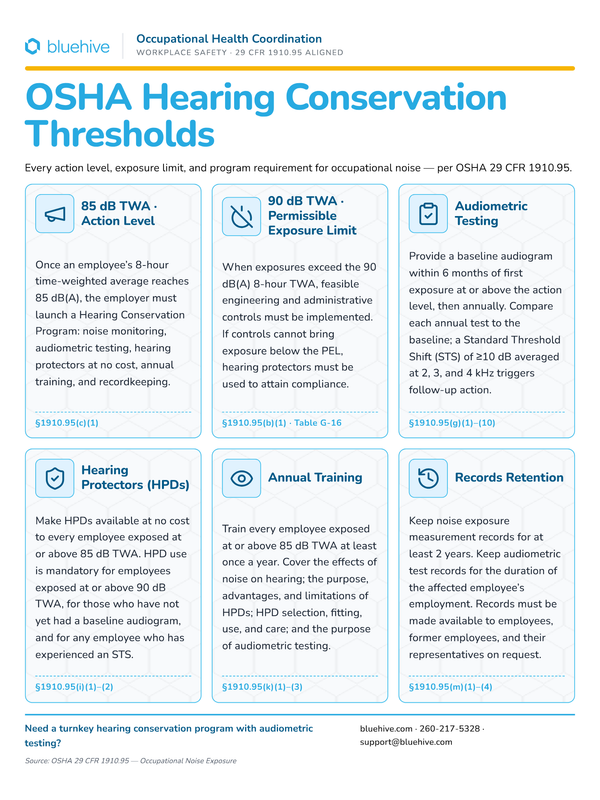
OSHA Hearing Conservation Thresholds Poster
A single-page reference covering OSHA’s entire hearing conservation framework under 29 CFR 1910.95. Spells out the 85 dB(A) 8-hour TWA action level that triggers a Hearing Conservation Program, the 90 dB(A) Permissible Exposure Limit that requires engineering and administrative controls, the audiometric testing schedule (baseline within 6 months, annual thereafter, Standard Threshold Shift criteria), hearing protector availability and mandatory-use rules, annual training requirements, and the records retention windows (2 years for noise measurements, duration of employment for audiograms). Each cell cites the exact CFR subsection so safety managers, plant supervisors, and HR can use it as both a wall poster and an audit reference.
What’s inside
- All six pillars of an OSHA hearing conservation program: action level, PEL, audiometric testing, hearing protectors, training, and records retention.
- Every cell cites the exact CFR subsection (§1910.95(b) through §1910.95(m)) so it doubles as a compliance reference for safety managers and industrial hygienists.
- Includes the Standard Threshold Shift (STS) trigger and the mandatory-use rules for hearing protection devices.
- Sized for manufacturing floors, maintenance shops, and safety bulletin boards on standard 8.5×11 paper.
- Pages
- 1
- Format
- Portrait · US Letter (8.5×11)
- Language
- English
Preview
One-page printable — preview below.
Regulatory basis
This printable summarises the requirements of the following federal regulation. Always consult the source text for the controlling language.
- Citation
- 29 CFR § 1910.95
- Title
- Occupational noise exposure
- Applies to
- Hearing-conservation requirements for employees exposed at or above an 8-hour TWA of 85 dB(A); engineering/administrative controls and PPE required at or above the 90 dB(A) PEL.
- Does not cover
- Hearing-conservation paragraphs (c) through (n) do not apply to employers engaged in oil and gas well drilling and servicing operations.
How to use this printable
- 1
Hang where the hazard happens
Post near loading docks, outdoor break areas, or wherever the risk shows up — not just the HR office.
- 2
Laminate for jobsite use
High-contrast type and bold hex callouts stay readable under glare and laminate sheets.
- 3
Refresh seasonally
Rotate heat-illness posters in spring, cold-stress in fall — fresh signage reads more than stale signage.
Editorial review
Last reviewed · BlueHive editorial review
More printables like this
All printables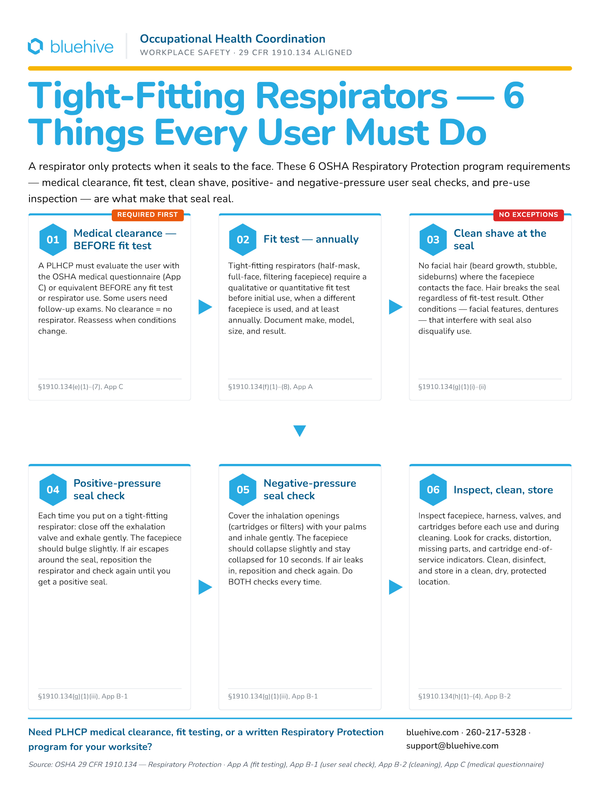
Respirator User Seal Check + Program Essentials Poster
The 6 OSHA Respiratory Protection program requirements for tight-fitting respirators — medical clearance before fit test, annual fit test, clean-shave seal, positive- and negative-pressure user seal checks, and inspect/clean/store. Anchored to 29 CFR 1910.134.
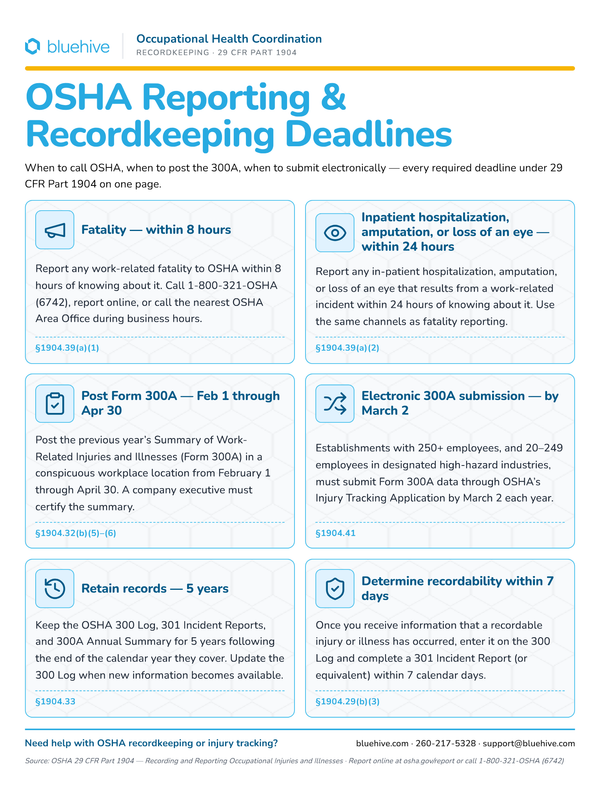
OSHA Reporting & Recordkeeping Deadlines Poster
Every OSHA injury reporting and recordkeeping deadline under 29 CFR Part 1904 on one page — 8-hour fatality, 24-hour hospitalization, 300A posting window, ITA submission, and 5-year retention.
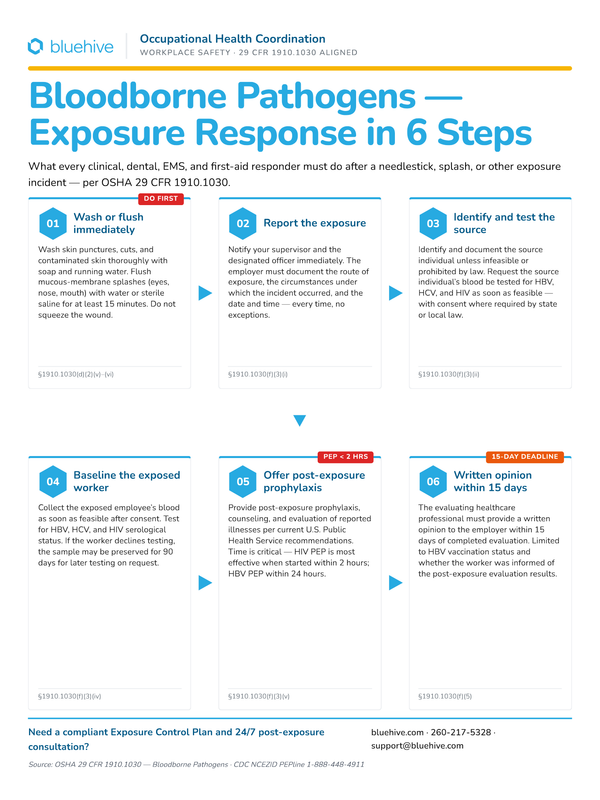
Bloodborne Pathogens Exposure Response Poster
The 6 steps every clinical, dental, EMS, and first-aid responder must take after a needlestick, splash, or other exposure incident — per 29 CFR 1910.1030.
Need a printable we don’t have yet?
Tell us what your front desk or HR office is missing. We’ll add it to the queue and ship it as a free download.