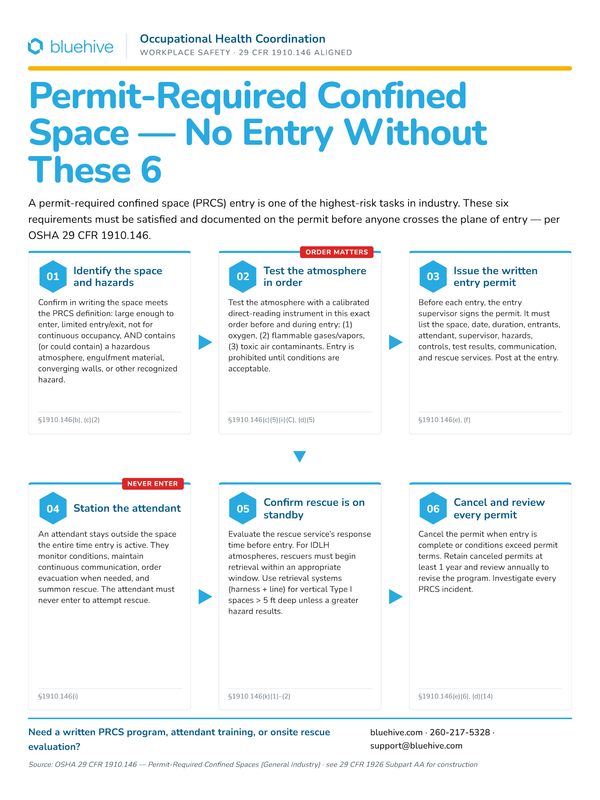
Permit-Required Confined Space Entry Poster
A single-page wall reference for the OSHA Permit-Required Confined Space (PRCS) standard, 29 CFR 1910.146. Six gating requirements that must be met before entry: identify the space and its hazards, test the atmosphere in OSHA-mandated order (oxygen, then flammables, then toxics), issue the written entry permit signed by the entry supervisor, station an attendant outside the space, evaluate rescue capability and rig retrieval systems for vertical Type I spaces, and cancel/retain/review every permit. Each requirement cites the exact 1910.146 subsection so the poster doubles as a competent-person reference for entry supervisors and attendants.
What’s inside
- All six PRCS pre-entry requirements in OSHA order — identify hazards, test atmosphere (O₂ → flammable → toxic), issue permit, station attendant, confirm rescue, cancel and review.
- Every requirement cites the exact 29 CFR 1910.146 subsection so the poster doubles as an entry-supervisor and attendant training reference.
- Spells out the mandatory atmospheric-testing order — the single most common audit finding in PRCS programs.
- Includes the attendant’s non-entry rule and the 1-year permit retention requirement.
- Sized for tank-farm operations, wastewater plants, pulp/paper mills, refineries, and any facility with vaults, silos, manholes, or process vessels — standard 8.5×11 paper.
- Pages
- 1
- Format
- Portrait · US Letter (8.5×11)
- Language
- English
Preview
One-page printable — preview below.
Regulatory basis
This printable summarises the requirements of the following federal regulation. Always consult the source text for the controlling language.
- Citation
- 29 CFR § 1910.146
- Title
- Permit-required confined spaces
- Applies to
- General-industry practices and procedures protecting employees from the hazards of entry into permit-required confined spaces.
- Does not cover
- Agriculture, construction, and shipyard employment.
How to use this printable
- 1
Hang where the hazard happens
Post near loading docks, outdoor break areas, or wherever the risk shows up — not just the HR office.
- 2
Laminate for jobsite use
High-contrast type and bold hex callouts stay readable under glare and laminate sheets.
- 3
Refresh seasonally
Rotate heat-illness posters in spring, cold-stress in fall — fresh signage reads more than stale signage.
Editorial review
Last reviewed · BlueHive editorial review
More printables like this
All printables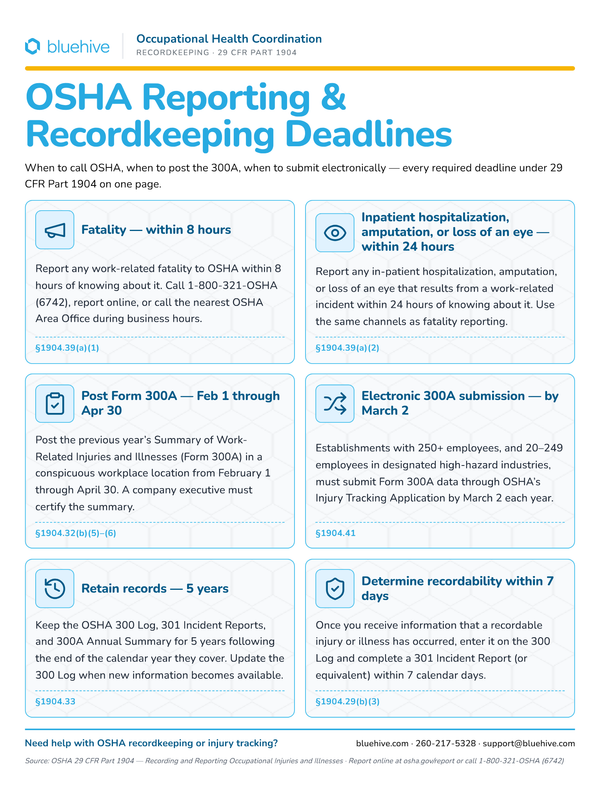
OSHA Reporting & Recordkeeping Deadlines Poster
Every OSHA injury reporting and recordkeeping deadline under 29 CFR Part 1904 on one page — 8-hour fatality, 24-hour hospitalization, 300A posting window, ITA submission, and 5-year retention.
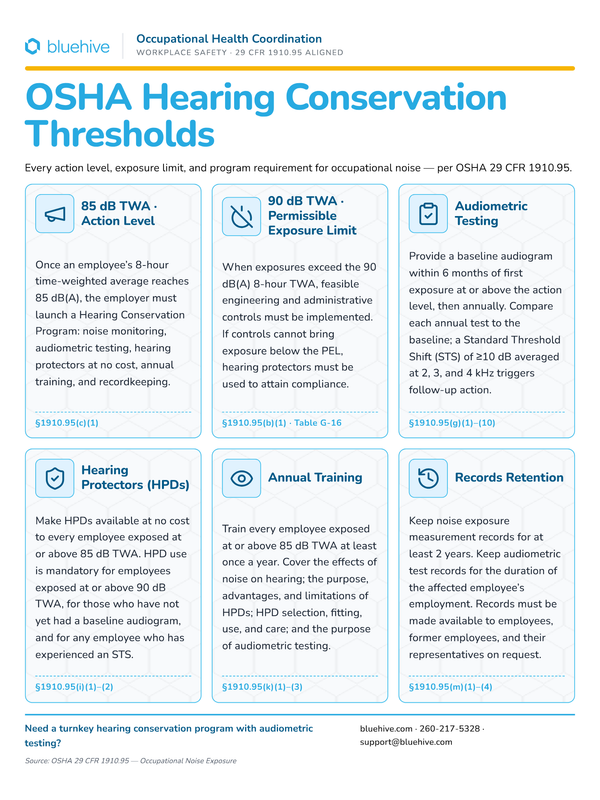
OSHA Hearing Conservation Thresholds Poster
Every action level, exposure limit, and program requirement for occupational noise on one page — 85 dB action level, 90 dB PEL, audiometric testing, HPDs, training, and records retention per 29 CFR 1910.95.
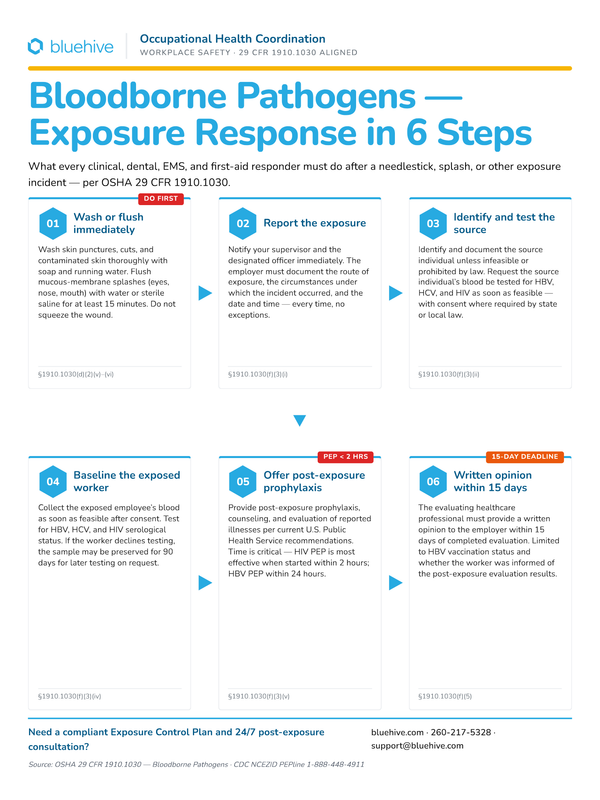
Bloodborne Pathogens Exposure Response Poster
The 6 steps every clinical, dental, EMS, and first-aid responder must take after a needlestick, splash, or other exposure incident — per 29 CFR 1910.1030.
Need a printable we don’t have yet?
Tell us what your front desk or HR office is missing. We’ll add it to the queue and ship it as a free download.