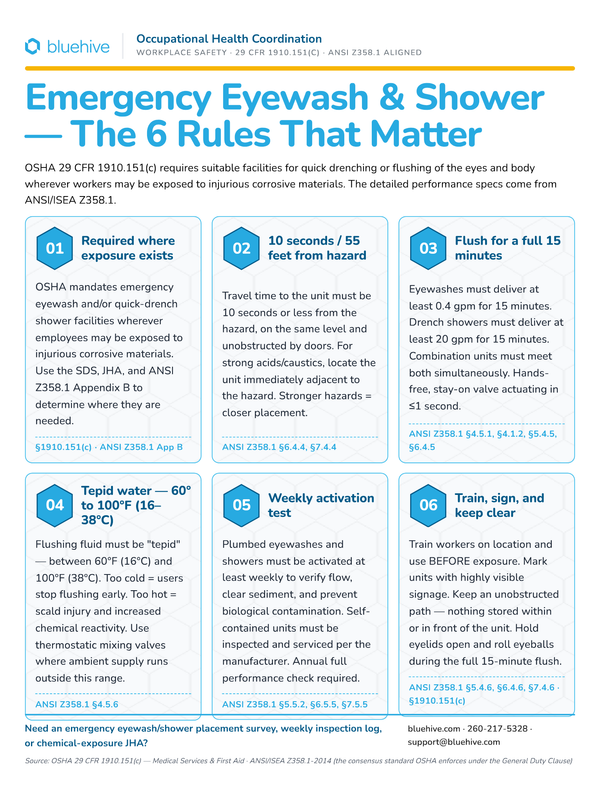
Emergency Eyewash & Shower Requirements Poster
A single-page wall reference for emergency eyewash and drench-shower facilities under OSHA 29 CFR 1910.151(c) and the consensus standard ANSI/ISEA Z358.1-2014 (which OSHA enforces under the General Duty Clause). Six rules: when units are required (anywhere injurious corrosive materials are present); the 10-second / 55-foot travel-time rule with closer placement for strong acids and caustics; minimum flow rates (0.4 gpm eyewash, 20 gpm shower) sustained for 15 minutes with hands-free stay-on valves activating in ≤1 second; tepid flushing fluid (60°–100°F) to prevent users from stopping the flush early or causing scald injury; weekly activation testing of plumbed units; and training, signage, and unobstructed access. Each rule cites the exact 1910.151(c) or Z358.1 subsection.
What’s inside
- All six OSHA-enforceable emergency eyewash and drench-shower rules — when required, 10-second travel rule, 15-minute flush rates, tepid 60–100°F water, weekly activation, training and signage.
- Cites both the OSHA standard (29 CFR 1910.151(c)) and the consensus standard (ANSI/ISEA Z358.1-2014) that OSHA enforces under the General Duty Clause.
- Spells out the difference between the 0.4 gpm eyewash flow rate and the 20 gpm drench-shower flow rate, both required for a full 15 minutes.
- Calls out the often-missed tepid-water requirement (60°–100°F) and the hands-free, stay-on valve actuating in ≤1 second.
- Sized for laboratories, paint shops, plating lines, battery rooms, water/wastewater facilities, and any workplace handling injurious corrosive materials on standard 8.5×11 paper.
- Pages
- 1
- Format
- Portrait · US Letter (8.5×11)
- Language
- English
Preview
One-page printable — preview below.
How to use this printable
- 1
Hang where the hazard happens
Post near loading docks, outdoor break areas, or wherever the risk shows up — not just the HR office.
- 2
Laminate for jobsite use
High-contrast type and bold hex callouts stay readable under glare and laminate sheets.
- 3
Refresh seasonally
Rotate heat-illness posters in spring, cold-stress in fall — fresh signage reads more than stale signage.
Editorial review
Last reviewed · BlueHive editorial review
More printables like this
All printables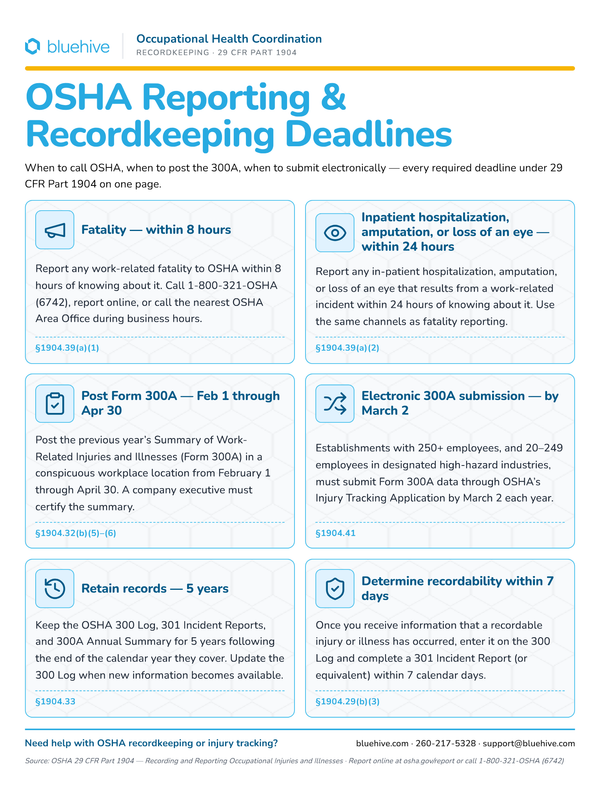
OSHA Reporting & Recordkeeping Deadlines Poster
Every OSHA injury reporting and recordkeeping deadline under 29 CFR Part 1904 on one page — 8-hour fatality, 24-hour hospitalization, 300A posting window, ITA submission, and 5-year retention.
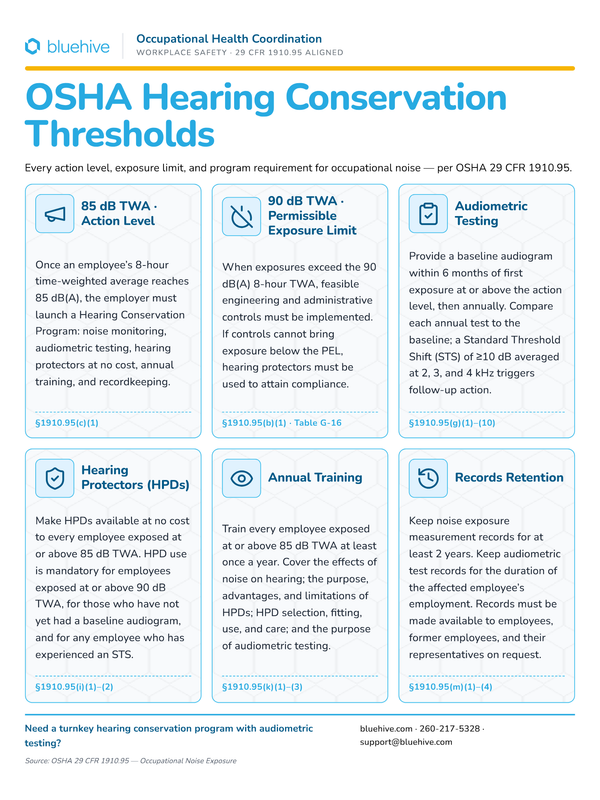
OSHA Hearing Conservation Thresholds Poster
Every action level, exposure limit, and program requirement for occupational noise on one page — 85 dB action level, 90 dB PEL, audiometric testing, HPDs, training, and records retention per 29 CFR 1910.95.
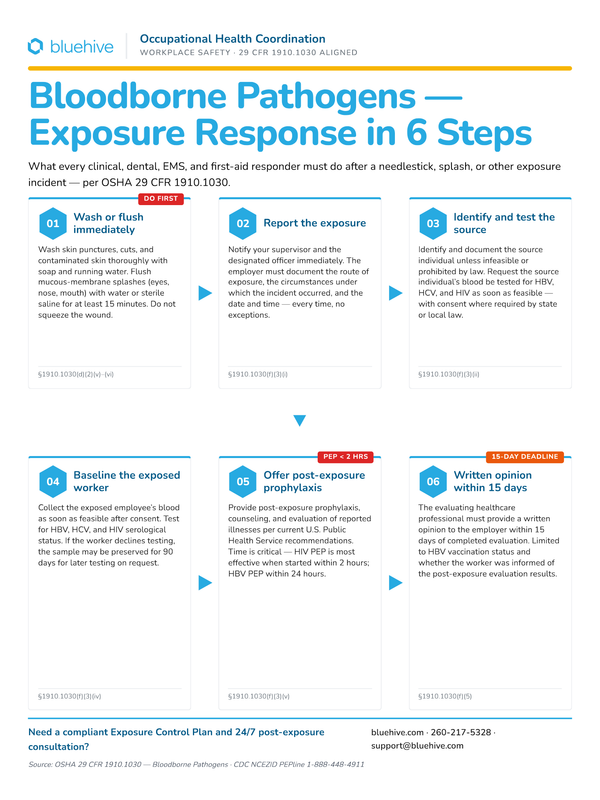
Bloodborne Pathogens Exposure Response Poster
The 6 steps every clinical, dental, EMS, and first-aid responder must take after a needlestick, splash, or other exposure incident — per 29 CFR 1910.1030.
Need a printable we don’t have yet?
Tell us what your front desk or HR office is missing. We’ll add it to the queue and ship it as a free download.