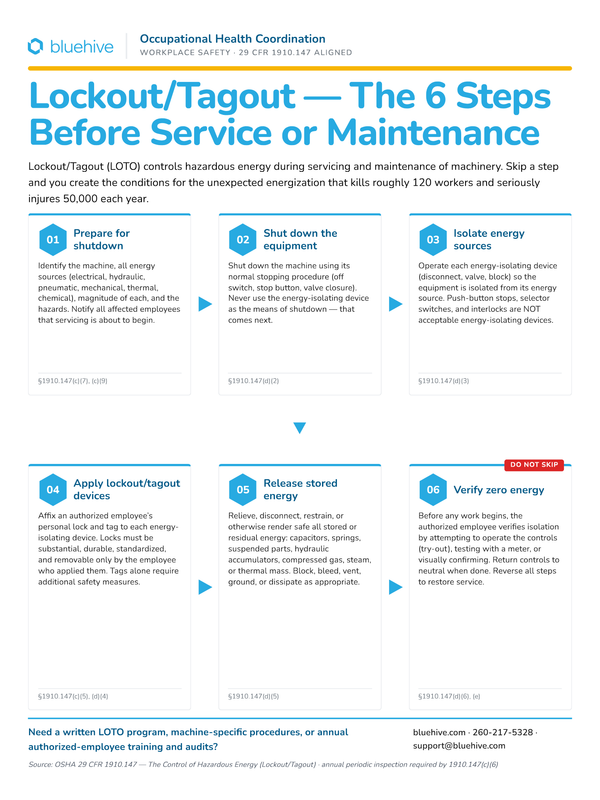
Lockout/Tagout (LOTO) 6 Steps Poster
A single-page wall reference for the OSHA Control of Hazardous Energy standard (29 CFR 1910.147). Six required steps in order: prepare for shutdown by identifying every energy source and magnitude, shut down using the normal stopping procedure, isolate at the energy-isolating device, apply the authorized employee’s personal lock and tag, release all stored/residual energy (mechanical, hydraulic, pneumatic, electrical, thermal), and verify zero energy by try-out before any work begins. Each step cites the exact 1910.147 subsection so the poster doubles as authorized- and affected-employee training documentation. LOTO consistently ranks in OSHA’s annual Top 10 most-cited standards.
What’s inside
- All six OSHA-required Lockout/Tagout steps in order — prepare for shutdown, shut down equipment, isolate energy sources, apply LOTO devices, release stored energy, verify zero energy.
- Every step cites the exact 29 CFR 1910.147 subsection so the poster doubles as authorized- and affected-employee training documentation.
- Spells out the difference between a normal stopping procedure and an energy-isolating device — a frequent audit finding.
- Reminds readers that push-button stops, selector switches, and interlocks are NOT acceptable energy-isolating devices.
- Sized for maintenance shops, electrical rooms, production floors, and equipment rooms on standard 8.5×11 paper.
- Pages
- 1
- Format
- Portrait · US Letter (8.5×11)
- Language
- English
Preview
One-page printable — preview below.
Regulatory basis
This printable summarises the requirements of the following federal regulation. Always consult the source text for the controlling language.
- Citation
- 29 CFR § 1910.147
- Title
- The control of hazardous energy (lockout/tagout)
- Applies to
- Servicing and maintenance of machines and equipment in which the unexpected energization, start-up, or release of stored energy could injure employees.
- Does not cover
- Construction, agriculture, maritime employment, electric-utility installations, and oil & gas well drilling and servicing.
How to use this printable
- 1
Hang where the hazard happens
Post near loading docks, outdoor break areas, or wherever the risk shows up — not just the HR office.
- 2
Laminate for jobsite use
High-contrast type and bold hex callouts stay readable under glare and laminate sheets.
- 3
Refresh seasonally
Rotate heat-illness posters in spring, cold-stress in fall — fresh signage reads more than stale signage.
Editorial review
Last reviewed · BlueHive editorial review
More printables like this
All printables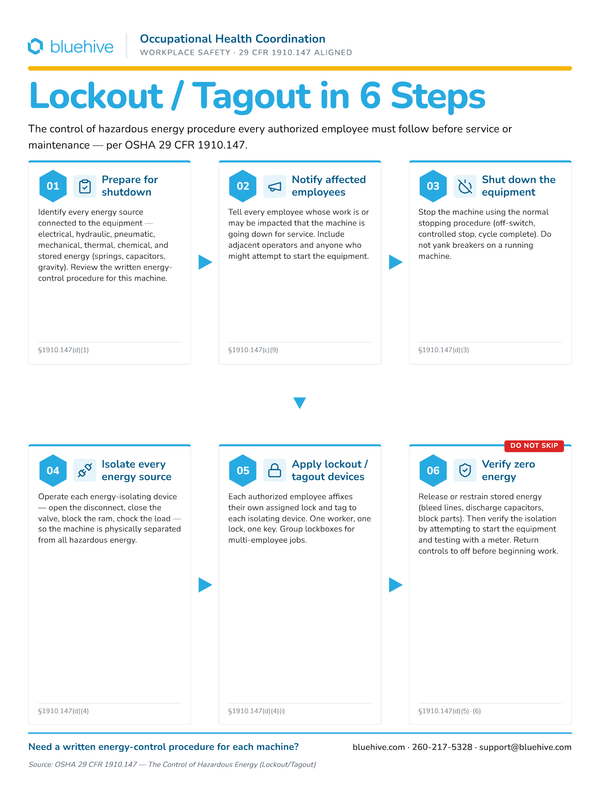
Lockout / Tagout 6-Step Poster
The six-step OSHA hazardous energy control procedure on one wall — for maintenance bays, control rooms, and authorized-employee training boards.
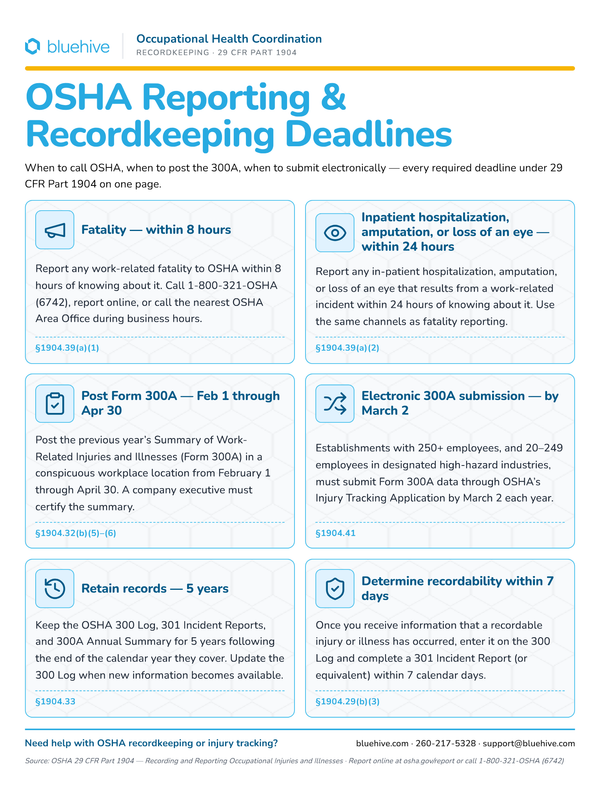
OSHA Reporting & Recordkeeping Deadlines Poster
Every OSHA injury reporting and recordkeeping deadline under 29 CFR Part 1904 on one page — 8-hour fatality, 24-hour hospitalization, 300A posting window, ITA submission, and 5-year retention.
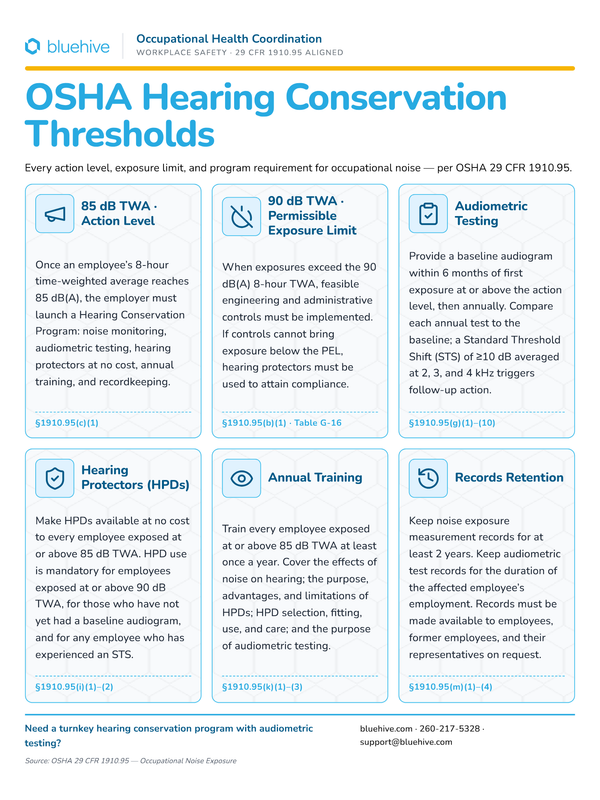
OSHA Hearing Conservation Thresholds Poster
Every action level, exposure limit, and program requirement for occupational noise on one page — 85 dB action level, 90 dB PEL, audiometric testing, HPDs, training, and records retention per 29 CFR 1910.95.
Need a printable we don’t have yet?
Tell us what your front desk or HR office is missing. We’ll add it to the queue and ship it as a free download.