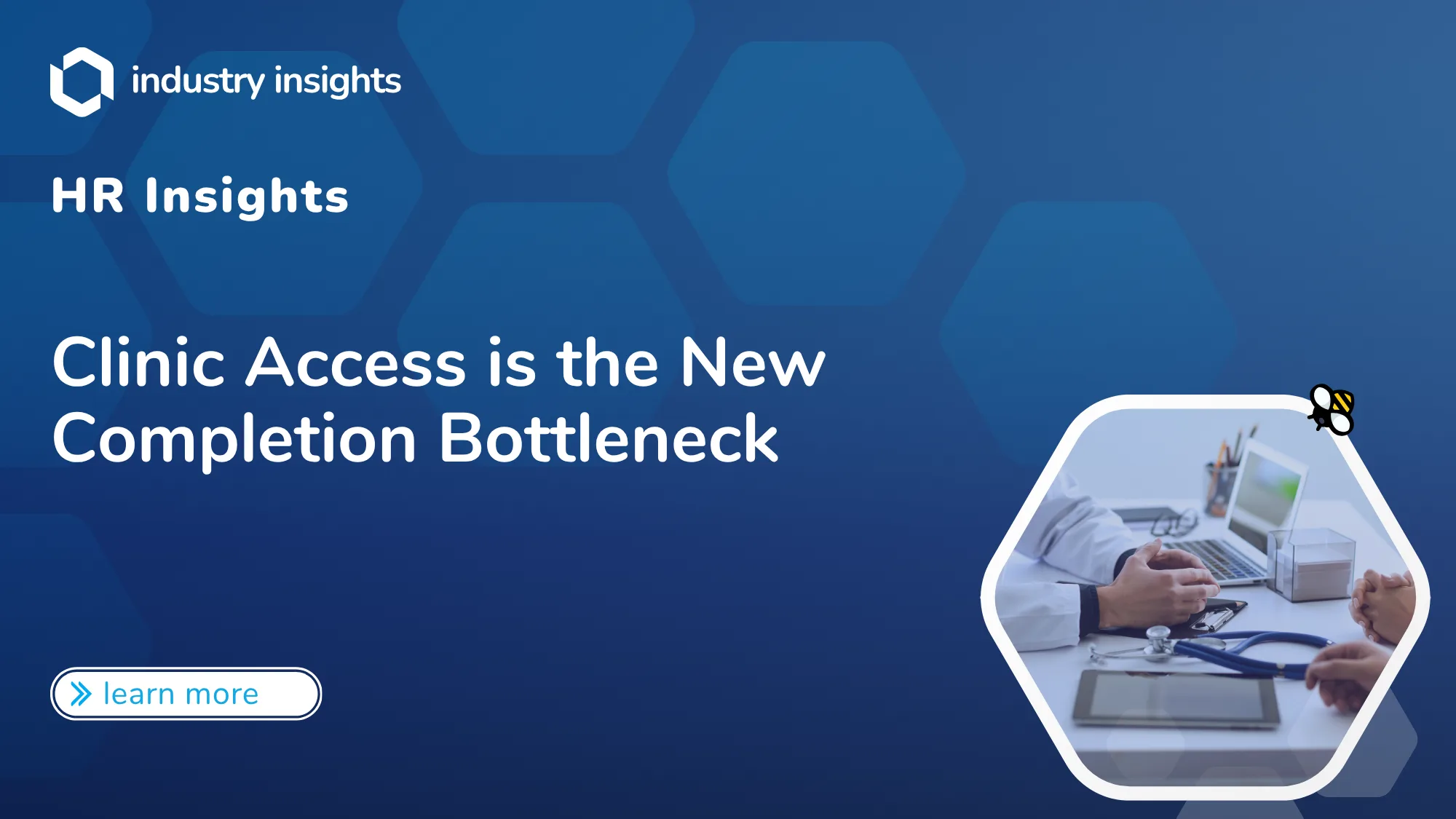
Clinic Access Is the New Completion Bottleneck
Executive Summary
Compliance rarely fails because employers forget the rules. It stalls when employees cannot complete required occupational health services quickly, correctly, and consistently. This HR Insights white paper explains why clinic access has become the new completion bottleneck and how employers can build a more scalable process.
Executive Summary
Compliance does not usually fall apart because an employer forgot that rules exist. HR teams, safety leaders, and operations managers know they need drug screenings, physicals, respirator evaluations, immunizations, medical surveillance, and role-specific clearances. The real challenge is often getting those services completed quickly, correctly, and consistently.
That is where clinic access becomes a bottleneck.
For employers with multiple worksites, distributed teams, field employees, seasonal hiring surges, or safety-sensitive roles, occupational health is not just a policy issue. It is a logistics issue. Employees need the right service, at the right clinic, in the right timeframe, with documentation that makes its way back to the employer without a game of inbox hide-and-seek.
OSHA emphasizes that safety and health programs help employers prevent injuries and illnesses, improve compliance, reduce costs, and increase productivity (Occupational Safety and Health Administration [OSHA], n.d.-a). But even a well-designed program can slow down if the provider network behind it is fragmented. Employers may have the right checklist, but if the nearest clinic does not perform the required service, does not understand the industry requirement, or cannot return documentation quickly, the entire process can stall.
This white paper explains why clinic access has become a practical compliance bottleneck, where breakdowns typically happen, and how employers can build a more scalable occupational health process.
Introduction
Most compliance conversations start with regulations: OSHA standards, DOT requirements, industry-specific protocols, state rules, or internal safety policies. Those are essential. But once the policy is written, the question becomes more operational:
Can employees actually complete the required health service without delaying the business?
For many employers, the answer is: sometimes.
A new hire may need a drug screen before starting work. A commercial driver may need a DOT physical from a certified medical examiner. A healthcare employee may need immunization documentation. A construction worker may need a respirator medical evaluation before fit testing. A manufacturing employee may need a physical tied to job demands. Each step seems manageable on its own, but when multiplied across locations, roles, vendors, and deadlines, the process can quickly become harder to control.
OSHA states that employers have a responsibility to provide a workplace free from serious recognized hazards and to comply with applicable standards, rules, and regulations. Some OSHA standards also require employers to provide medical screening and surveillance when applicable (OSHA, n.d.-b). In other words, health compliance is not just about having a binder on a shelf. It is about making sure required actions actually happen.
And that is where provider access matters.
Why Clinic Access Is Getting Harder to Manage
Occupational health needs have expanded beyond the classic "send someone to the clinic" model. Today's employers are dealing with hybrid workforces, multi-state operations, mobile employees, shifting workforce demographics, tighter hiring timelines, and more specialized job requirements.
At the same time, provider access is not evenly distributed. HRSA tracks Health Professional Shortage Areas for primary care, dental health, and mental health, showing that access to healthcare resources varies significantly by geography (Health Resources and Services Administration [HRSA], n.d.). Even when an area has healthcare providers, not every clinic offers occupational health services. Fewer still may offer the specific services an employer needs, such as DOT exams, respirator evaluations, regulated drug testing, immunizations, or job-specific physicals.
This creates a practical problem: employers may technically have a compliance process, but employees may still struggle to find a qualified, available, and convenient provider.
The pressure is not going away. The U.S. Bureau of Labor Statistics projects employment for occupational health and safety specialists and technicians to grow 12 percent from 2024 to 2034, much faster than the average for all occupations (U.S. Bureau of Labor Statistics, 2025). That growth reflects a continued need for safety and health expertise across industries. But expertise inside the employer's organization still needs to connect with reliable clinical execution in the field.
In plain English: someone still has to get the appointment done.
Where Occupational Health Processes Break Down
Clinic access problems are rarely dramatic at first. They usually show up as small delays, repeated questions, unclear handoffs, or extra follow-up. But those small issues can become expensive quickly when they affect hiring, onboarding, compliance deadlines, or employee readiness.
1. The Employee Is Sent to the Wrong Clinic
Not every clinic performs every service. A location may offer basic urgent care but not DOT physicals, respirator medical evaluations, or regulated collection services. HR may only discover this after the employee has already arrived, waited, and been turned away.
That is not a compliance strategy. That is a scavenger hunt with a waiting room.
2. The Clinic Offers the Service, But Not in the Required Format
Some services have strict rules. For example, DOT-regulated drug and alcohol testing follows procedures under 49 CFR Part 40, which applies to transportation employers, safety-sensitive employees, and service agents involved in required testing (49 C.F.R. pt. 40). A clinic that performs general drug testing may not be the right fit for a DOT-regulated test.
Similarly, interstate commercial motor vehicle drivers must obtain a physical qualification examination and Medical Examiner's Certificate from a certified medical examiner listed on the FMCSA National Registry (Federal Motor Carrier Safety Administration [FMCSA], 2023).
The distinction matters. A completed appointment is only useful if it satisfies the actual requirement.
3. Documentation Gets Delayed or Lost
In many organizations, completion tracking still depends on emails, faxes, portals, spreadsheets, phone calls, and a fair amount of hope. When documentation is delayed, HR may not know whether the employee is cleared, pending, missing information, or simply stuck somewhere in the process.
That creates unnecessary risk. It also creates a poor employee experience, especially for candidates who are ready to start but waiting on paperwork.
4. Multi-location Hiring Creates Inconsistent Workflows
A company may have a strong provider relationship in one market, but no reliable option in another. One region may send candidates to a familiar clinic, while another relies on manual searches every time a role opens.
This can create uneven employee experiences and inconsistent compliance documentation. For HR teams, it also means more time spent solving the same problem in different ZIP codes.
5. Role-based Requirements Are Not Always Clear at Scheduling
Occupational health services should match the job, risk profile, and regulatory requirement. A warehouse associate, CDL driver, healthcare worker, firefighter, and construction employee may each need different services.
Without a clear system for matching roles to services, employees can be sent for incomplete or incorrect appointments. That can trigger rework, delays, and frustration for everyone involved.
High-Impact Services Most Affected by Access Gaps
Clinic access is especially important when services are time-sensitive, regulated, or tied directly to whether an employee can begin work.
Drug and Alcohol Testing
Drug screening is often a pre-employment or safety-sensitive requirement. For DOT-regulated roles, 49 CFR Part 40 establishes required procedures for workplace drug and alcohol testing in federally regulated transportation industries (U.S. Department of Transportation, n.d.; 49 C.F.R. pt. 40).
For non-DOT employers, drug-free workplace programs can also support safety and wellness goals. SAMHSA's Drug-Free Workplace Toolkit provides resources to help employers develop and sustain drug-free workplace policies and programs, including prevention, workplace wellness, and employee support considerations (Substance Abuse and Mental Health Services Administration [SAMHSA], n.d.).
The access issue: testing must be easy to schedule, properly matched to the employer's program, and documented quickly.
DOT Physicals
For interstate commercial motor vehicle drivers, DOT physicals must be performed by certified medical examiners listed on the FMCSA National Registry. FMCSA notes that certified medical examiners are listed on the National Registry and are able to conduct examinations of interstate CMV drivers once certified (FMCSA, 2023).
The access issue: a nearby clinic is not enough. The examiner must be properly certified.
Respirator Medical Evaluations and Fit Testing
Under OSHA's respiratory protection standard, employers must provide a medical evaluation to determine an employee's ability to use a respirator before the employee is fit tested or required to use the respirator in the workplace. OSHA also requires fit testing before an employee uses a tight-fitting respirator with a negative or positive pressure facepiece (29 C.F.R. § 1910.134).
The access issue: respirator compliance often requires the right sequence. Medical evaluation first, then fit testing. Skipping steps or scheduling out of order can delay clearance.
Immunizations and Healthcare Worker Requirements
Healthcare workers may need to stay current on routine vaccines and additional vaccines based on role or exposure risk. HHS notes that healthcare workers who work directly with patients or handle body fluids are more likely to get and spread serious diseases, and it identifies routine vaccines, annual flu shots, and additional vaccines such as hepatitis B as important considerations (U.S. Department of Health and Human Services [HHS], 2026).
The access issue: immunization documentation, titer testing, and follow-up doses can become complex when employees are spread across locations or onboarding quickly.
Physicals, Medical Surveillance, and Role-Specific Clearances
Many employers use occupational health exams to confirm that employees can safely perform role-specific tasks. These may include pre-placement physicals, return-to-work exams, surveillance exams, or evaluations connected to specific hazards.
The access issue: the clinic needs to understand what the employer is asking for, what documentation is required, and how the result should be communicated.
The Business Cost of Slow Clinic Access
When clinic access breaks down, the cost is not just administrative annoyance. It affects hiring velocity, workforce readiness, employee trust, and compliance confidence.
Delayed Start Dates
If a candidate cannot complete a required screening or physical in time, the start date may slip. That can create staffing gaps, overtime pressure, and frustration for managers who expected the person to be cleared.
More HR Follow-Up
Every unclear appointment creates extra work. HR may need to call the clinic, contact the employee, resend forms, verify requirements, or track down missing documentation. Multiply that by dozens or hundreds of employees, and the process becomes a full-time side quest.
Candidate and Employee Frustration
Employees rarely see the behind-the-scenes complexity. They just know they were told to go somewhere, the appointment did not work, or nobody can tell them what happens next. A confusing health clearance process can make onboarding feel harder than it needs to be.
Higher Compliance Risk
Compliance depends on both completion and documentation. If the right service is not completed, or if documentation is missing, the employer may not be able to show that the requirement was satisfied.
Inconsistent Experience Across Locations
A process that works in one region but not another is hard to scale. Multi-location employers need repeatable workflows, not one-off problem solving every time hiring expands into a new market.
What Employers Should Look For in an Occupational Health Partner
A stronger occupational health process starts with one key question:
Can this partner help us get the right employee to the right service at the right time, and help us know when it is done?
Employers should evaluate occupational health partners across seven practical areas.
1. Network Depth
A broad provider network matters, but coverage should be service-specific. Employers should ask whether providers can perform the actual services needed, not just whether clinics exist in a region.
2. Service Visibility
HR should be able to identify which clinics offer drug screens, DOT exams, respirator evaluations, immunizations, physicals, or other required services before sending an employee.
3. Geographic Scalability
Multi-state employers need consistent processes across markets. A provider strategy should support hiring and compliance across urban, suburban, rural, and field-based locations.
4. Role-based workflows
The system should connect job roles to the right services. That helps prevent incomplete appointments and unnecessary rework.
5. Documentation tracking
Employers need visibility into status: scheduled, completed, pending, missing information, or cleared. Documentation should not depend on a heroic HR professional checking 14 tabs before lunch.
6. Employee Experience
A good process should be clear for employees. They should know where to go, what to bring, what to expect, and what happens after the appointment.
7. Compliance Alignment
The partner should understand the difference between general health services and regulated requirements. DOT testing, DOT physicals, respirator clearance, and healthcare immunization workflows each have unique considerations.
How BlueHive Helps Reduce Friction
BlueHive helps employers simplify occupational health compliance by connecting organizations, employees, and providers through a more coordinated network model.
Instead of forcing HR teams to manually locate clinics, confirm services, manage communication, and chase documentation, BlueHive supports a more streamlined process for scheduling and tracking occupational health services. That can include drug screenings, physical examinations, immunizations, respirator-related services, health risk assessments, wellness assessments, and other workforce health needs.
For employers, this means fewer disconnected workflows. For employees, it means a clearer path to completing required services. For providers, it means better visibility and connection to employers who need occupational health support.
Most importantly, BlueHive helps shift occupational health from reactive problem solving to proactive workforce readiness.
That shift aligns with modern workplace health thinking. CDC describes effective workplace health programs as coordinated, systematic, and comprehensive, with the potential to improve worker health, reduce risk, support productivity, and improve workplace culture (Centers for Disease Control and Prevention [CDC], 2024). NIOSH's Total Worker Health approach similarly emphasizes policies, programs, and practices that integrate protection from work-related hazards with efforts to advance worker well-being (National Institute for Occupational Safety and Health [NIOSH], 2024).
In other words, occupational health should not feel like a disconnected errand. It should be part of a stronger, safer, and more people-centered workforce strategy.
A Practical Clinic Access Checklist for Employers
Use this checklist to identify where your occupational health process may be slowing down.
Provider Network
- Do we know which clinics offer each required service?
- Do we have coverage in every location where we hire or operate?
- Do we have backup options if a clinic is unavailable?
- Can we support employees in rural or underserved areas?
Service Matching
- Are services mapped by role, location, and requirement?
- Do we distinguish between DOT and non-DOT testing?
- Do we confirm when a certified medical examiner is required?
- Do we schedule respirator medical evaluations before fit testing?
Employee Communication
- Do employees receive clear appointment instructions?
- Do they know what documents or identification to bring?
- Do they understand whether the service is required before their start date?
- Do they have support if a clinic cannot complete the service?
Documentation
- Can HR see appointment status without manual follow-up?
- Are results and clearance documents returned consistently?
- Are incomplete or pending items flagged quickly?
- Is documentation stored in a way that supports audits and internal review?
Scalability
- Can the process support hiring surges?
- Can it expand to new states or regions?
- Is the process consistent across departments and locations?
- Can managers and HR teams rely on the same workflow?
Five Steps to Build a Better Occupational Health Access Strategy
Step 1: Audit Your Current Process
Start by mapping the employee journey from service request to clearance. Identify every handoff, system, email, vendor, clinic, and manual step. Pay special attention to places where HR has to intervene.
Step 2: Identify Your Most Common Delays
Track the services that most often slow hiring or readiness. Common culprits include drug screen documentation, unavailable appointment times, incorrect clinic selection, DOT physical scheduling, and missing immunization records.
Step 3: Map Requirements by Role
Create a clear matrix that connects job roles to required services. Include the service type, timing, documentation needed, and any regulatory considerations.
Step 4: Strengthen Provider Visibility
Do not assume every clinic can do every occupational health service. Build or use a network that gives your team visibility into service capabilities by location.
Step 5: Centralize Tracking
A compliance process should make status easy to see. HR should not have to wonder whether an employee is cleared, pending, or stuck. Centralized tracking helps teams act faster and reduces the chance of missed requirements.
Conclusion
Employers often focus on the policy side of compliance, and for good reason. Rules matter. Requirements matter. Documentation matters.
But the employee experience matters too. So does the operational reality of getting services completed across locations, roles, and timelines.
Clinic access is the new compliance bottleneck because it sits at the point where policy meets real life. A requirement is only useful if employees can complete it. A checklist only works if the right provider is available. A clearance process only protects the business if documentation comes back clearly and consistently.
For HR teams, safety leaders, and operations managers, the next step is not just asking, "What do we require?"
It is asking, "Can our people complete what we require without unnecessary friction?"
BlueHive helps employers answer that question with confidence by making occupational health services easier to coordinate, easier to track, and easier to scale.
Ready to take the guesswork out of occupational health compliance? BlueHive connects employers to a nationwide network of providers so teams can schedule faster, track easier, and keep their workforce moving.
Sources
-
Centers for Disease Control and Prevention. (2024, July 15). CDC workplace health model. https://www.cdc.gov/workplace-health-promotion/php/model/index.html
-
Electronic Code of Federal Regulations. (n.d.). Procedures for transportation workplace drug and alcohol testing programs, 49 C.F.R. pt. 40. Retrieved June 22, 2026, from https://www.ecfr.gov/current/title-49/subtitle-A/part-40
-
Electronic Code of Federal Regulations. (n.d.). Respiratory protection, 29 C.F.R. § 1910.134. Retrieved June 22, 2026, from https://www.ecfr.gov/current/title-29/subtitle-B/chapter-XVII/part-1910/subpart-I/section-1910.134
-
Federal Motor Carrier Safety Administration. (2023, April 4). National Registry of Certified Medical Examiners. https://www.fmcsa.dot.gov/regulations/national-registry/national-registry-certified-medical-examiners
-
Health Resources and Services Administration. (n.d.). Map gallery: Health Professional Shortage Areas. Retrieved June 22, 2026, from https://data.hrsa.gov/topics/health-workforce/shortage-areas/map-gallery-hpsa
-
National Institute for Occupational Safety and Health. (2024, May 31). About the Total Worker Health approach. Centers for Disease Control and Prevention. https://www.cdc.gov/niosh/twh/about/index.html
-
Occupational Safety and Health Administration. (n.d.-a). Recommended practices for safety and health programs. U.S. Department of Labor. Retrieved June 22, 2026, from https://www.osha.gov/safety-management
-
Occupational Safety and Health Administration. (n.d.-b). Employer responsibilities. U.S. Department of Labor. Retrieved June 22, 2026, from https://www.osha.gov/workers/employer-responsibilities
-
Substance Abuse and Mental Health Services Administration. (n.d.). Drug-Free Workplace Toolkit. Retrieved June 22, 2026, from https://www.samhsa.gov/substance-use/drug-free-workplace/employer-resources/toolkit
-
U.S. Bureau of Labor Statistics. (2025, August 28). Occupational health and safety specialists and technicians: Occupational Outlook Handbook. U.S. Department of Labor. https://www.bls.gov/ooh/healthcare/occupational-health-and-safety-specialists-and-technicians.htm
-
U.S. Department of Health and Human Services. (2026, April 23). Vaccines for health care workers. https://www.hhs.gov/immunization/who-and-when/health-care-workers/index.html
-
U.S. Department of Transportation. (n.d.). Procedures for transportation workplace drug and alcohol testing programs. Retrieved June 22, 2026, from https://www.transportation.gov/odapc/part40
Stay Current on OSHA & Workplace Safety
State regulations change frequently. Track the latest updates in our Compliance Watch.
View OSHA & Workplace Safety Updates
Content Developer
66 articles
Chris Davis is a content developer at BlueHive Health with a background in healthcare operations, medical billing, and small-business management. He writes plain-English guides on OSHA, DOT, and PHMSA compliance for HR and safety leaders.
Related White Papers
 White Paper
Your Hiring Process is a Candidate Experience: How Occupational Health Steps Can Build Trust
Chris Davis·44 min read White Paper
Top 5 Occupational Health Compliance Mistakes HR Teams Still Make in 2025
Chris Davis·5 min read White Paper
Scheduled Is Not Cleared: The Hidden Delays Between Clinic Visit and Workforce Readiness
Chris Davis·13 min readReady to streamline your occupational health program?
BlueHive connects you to 20,000+ clinics nationwide with real-time scheduling and results.