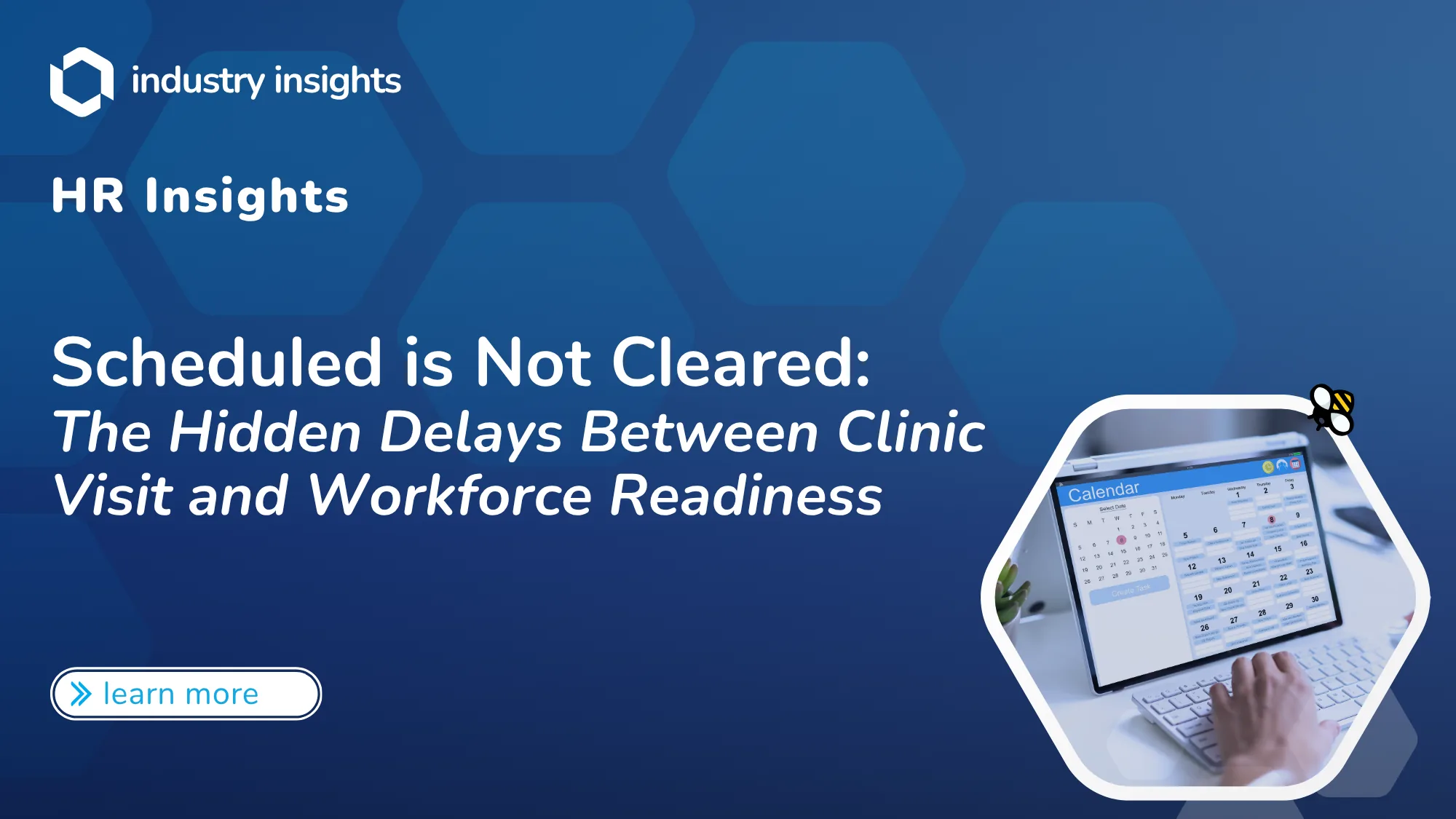
Scheduled Is Not Cleared: The Hidden Delays Between Clinic Visit and Workforce Readiness
Executive Summary
Scheduling an occupational health appointment can feel like the finish line — but it is often only the midpoint. This HR Insights whitepaper unpacks the “last mile” of workforce compliance: the space between a scheduled appointment and a cleared employee, where HR teams lose time, visibility, and confidence.
Executive Summary
For HR and compliance teams, scheduling an occupational health appointment can feel like the finish line. After all, the clinic has been found, the employee has been notified, and the service is on the calendar. But in practice, the appointment is often only the midpoint.
An employee is not truly ready to work until the required service is completed, the result or documentation is received, the information is reviewed, and the employer has a clear status. That last part matters. A missing drug screen result, incomplete physical form, delayed TB test follow-up, or unsigned clinic document can hold up a start date just as much as not having a clinic at all.
This is the "last mile" of workforce compliance: the space between a scheduled appointment and a cleared employee. It is where HR teams often lose time, visibility, and confidence.
Federal requirements reinforce the importance of this gap. DOT rules for regulated transportation employers outline required drug and alcohol testing procedures, and DOT regulations make clear that employers remain responsible for compliance even when they use service agents (U.S. Department of Transportation, n.d.; Office of the Secretary of Transportation, 2026a). Employers must also obtain required information from service agents and may not treat silence as clearance for a safety-sensitive role (Office of the Secretary of Transportation, 2026b). OSHA recordkeeping requirements similarly show that workplace health and safety compliance depends on accurate records, reporting, and documentation, not just the event itself (Occupational Safety and Health Administration [OSHA], n.d.).
For employers, the takeaway is simple: scheduled is not the same as cleared. A stronger occupational health process must track the full path from order to appointment, appointment to result, and result to work-readiness.
The Appointment Is Not the Finish Line
In a perfect world, occupational health compliance would move in a straight line. HR requests a service, the employee visits a clinic, the result comes back, and the employee starts work on time.
Real life is usually messier.
The clinic may not send the result right away. The employee may miss the appointment. A physical form may be missing a provider signature. A TB test may require a second visit. A drug screen may be waiting on MRO review. A vaccine record may be incomplete. The clinic may fax documentation to the wrong number, or the result may sit in an inbox no one is monitoring.
None of these problems are dramatic on their own. That is what makes them dangerous. They are small enough to seem routine, but large enough to delay hiring, onboarding, compliance reviews, and workforce planning.
The last whitepaper in this series focused on clinic access as the new compliance bottleneck. That problem is real. Employers need reliable access to clinics that can perform the right services, accept the right payment process, meet timing needs, and understand occupational health requirements. But access alone does not guarantee clearance. Getting an employee into the clinic is only one part of the workflow.
The bigger question is: what happens next?
The Hidden Gap Between Scheduled and Cleared
There is a meaningful difference between a scheduled service and a completed clearance.
A scheduled service means the employee has a place to go.
A completed clearance means the employer has the documentation needed to make a work-readiness decision.
That distinction matters most in industries where employees cannot begin certain duties until health, safety, or compliance requirements are complete. Transportation employers, for example, must follow DOT drug and alcohol testing procedures for federally regulated testing programs (U.S. Department of Transportation, n.d.). In DOT-regulated contexts, employers may use service agents, but they remain responsible for compliance with applicable drug and alcohol testing requirements (Office of the Secretary of Transportation, 2026a).
That means a delayed result is not just an administrative inconvenience. It can become an operational blocker. DOT rules specifically state that an employer must not assume "no news is good news" and allow an applicant to perform safety-sensitive duties before receiving a required pre-employment drug test result (Office of the Secretary of Transportation, 2026b).
This principle applies beyond DOT testing, even when the exact rules differ. For many employers, the question is not simply whether the appointment happened. The question is whether the employer has reliable proof that the requirement has been satisfied.
Common Last-Mile Delays Include:
- Drug screen results still pending
- Physical exam forms missing signatures or required fields
- TB skin tests requiring a second visit for reading
- TB blood test results not yet returned
- Immunization records missing documentation
- Results sent to the wrong contact
- Clinic documentation that needs correction
- Employee no-shows or incomplete visits
- MRO review delays
- Provider follow-up handled through phone, fax, or scattered email
This is where compliance teams can get stuck in what feels like a never-ending loop of "just checking in." And yes, "just checking in" may be the unofficial theme song of HR inboxes everywhere.
From Scheduled to Cleared
Scheduled is not cleared — walk the full lifecycle, not just the appointment.
Scheduled · Step 1
Order intake
The service is requested and the requirement is defined — the right test, for the right role.
Step 1 of 9
Why the Last Mile Is Getting Harder
Occupational health workflows are becoming more complex because employers are managing more requirements across more locations, roles, and worker types.
Healthcare employers may need TB screening, immunization documentation, respirator fit testing, physicals, or other role-specific clearances. CDC guidance states that U.S. health care personnel should be screened for TB upon hire, and that screening includes a baseline individual risk assessment, symptom evaluation, TB test, and additional evaluation for TB disease when needed (Centers for Disease Control and Prevention [CDC], 2023). CDC also notes that state and local TB regulations may differ, which adds another layer of complexity for employers operating across multiple jurisdictions.
Healthcare vaccination requirements and recommendations can also vary by role, facility policy, and jurisdiction. HHS states that health care workers who work directly with patients or handle body fluids are more likely to get and spread serious diseases, and it encourages health care workers to stay up to date on vaccines recommended for their age and work setting (U.S. Department of Health and Human Services [HHS], 2026).
Transportation employers face their own documentation burden. In the FMCSA Drug and Alcohol Clearinghouse return-to-duty process, employers and SAPs have specific reporting responsibilities. FMCSA states that employers may designate a consortium or third-party administrator to assist with reporting, but the employer retains ultimate responsibility for compliance (Federal Motor Carrier Safety Administration [FMCSA], 2020).
Federal workplace drug testing programs also continue to evolve. In 2026, HHS published the current authorized drug testing panels and required report nomenclature for federal workplace drug testing programs, stating that the current panels and nomenclature remained in effect and applied to both urine and oral fluid testing (Substance Abuse and Mental Health Services Administration [SAMHSA], 2026).
The point is not that every employer has the same requirements. They do not. The point is that occupational health compliance depends on the details. The right test, the right clinic, the right documentation, the right timing, and the right follow-up all need to connect.
When that process lives across phone calls, spreadsheets, fax machines, email threads, and memory, things get missed.
The Cost of Unclear Status
The most frustrating part of the last-mile problem is uncertainty.
A missing result is a problem. But not knowing whether the result is missing, delayed, sent to the wrong place, waiting on review, or never completed is often the bigger issue.
Unclear status creates several operational problems.
First, HR loses time. Instead of focusing on onboarding, employee support, or workforce planning, teams spend hours chasing clinics, checking inboxes, calling employees, and updating managers. The work may be necessary, but it is reactive.
Second, hiring managers lose confidence. If a manager does not know whether an employee can start Monday, they cannot plan coverage, training, routes, shifts, or assignments. That uncertainty can ripple across the business.
Third, employees have a worse experience. From the employee's perspective, they did what they were asked to do. They went to the clinic. If the process stalls after that, the delay may feel confusing or unfair. A candidate waiting on clearance may not understand that HR is still waiting on a form, a lab result, or a provider correction.
Fourth, compliance teams lose visibility. Documentation is not just paperwork. OSHA's recordkeeping framework highlights the importance of recording, reporting, and electronic submission for covered workplace injury and illness information (OSHA, n.d.). While not every occupational health service falls under OSHA recordkeeping, the broader lesson still applies: compliance processes depend on records that are accurate, accessible, and complete.
Finally, clinics feel the pressure too. When employer workflows are fragmented, providers may receive repeated calls asking for updates, corrections, or duplicate documentation. That adds friction to the employer-provider relationship and can slow the process even more.
The cost is not just the missing document. The cost is the uncertainty around the missing document.
What a Better Clearance Workflow Looks Like
A better clearance workflow starts with a simple shift in mindset: the order is not complete until the status is clear.
That does not mean every service needs to be overcomplicated. It means the process should make it obvious where each employee stands.
A strong occupational health workflow should answer several questions quickly:
- Has the appointment been scheduled?
- Did the employee complete the visit?
- Were the results received?
- Is the documentation complete?
- Is anything missing or incorrect?
- Who owns the next follow-up?
- Can the employee begin work, or is the clearance still pending?
Is Your Clearance Workflow Ready?
7 quick questions to see whether your team is truly cleared — not just scheduled.
Question 1 of 7
Has the appointment been scheduled?
Employers can strengthen this process by building a workflow around the full order lifecycle, not just the appointment. That includes order intake, clinic matching, employee instructions, appointment tracking, provider follow-up, result retrieval, document review, exception handling, and final status updates.
This is especially important when a single employer manages multiple service types. Drug screens, physicals, TB testing, immunizations, respirator fit testing, and fitness-for-duty exams each have different timelines and documentation needs. Treating them all as "clinic appointments" can hide important differences.
For example, a same-day physical may still require a corrected form if the clinic misses a field. A TB skin test may require the employee to return for reading. A drug screen may require lab processing and MRO review before the result is available. A vaccine requirement may depend on documentation of prior immunity, not just a new appointment.
The workflow should be designed for these realities.
The Role of Accountability
One of the clearest lessons from regulated testing programs is that outsourcing tasks does not eliminate employer responsibility.
DOT rules allow employers to use service agents to help meet drug and alcohol testing requirements, but employers remain responsible for compliance (Office of the Secretary of Transportation, 2026a). DOT rules also state that employers are responsible for obtaining required information from service agents, even when using a C/TPA as an intermediary (Office of the Secretary of Transportation, 2026b).
For HR teams, that creates a practical challenge. They may not personally collect the specimen, perform the exam, run the lab test, review the result, or complete the form. But they still need a reliable process for knowing what happened.
That is why accountability in occupational health cannot stop at "we sent the employee to the clinic." It has to include follow-up ownership.
Someone, or some system, needs to know which orders are open, which are delayed, which need provider action, which need employee action, and which are ready for employer review.
Without that structure, the process depends on individual heroics. And while every HR team has at least one person who can somehow find a missing fax from three Thursdays ago, "heroic fax detective" is not a scalable operating model.
How BlueHive Helps Close the Gap
BlueHive helps employers move beyond appointment scheduling and toward clearer workforce readiness.
Through access to a large occupational health provider network, BlueHive helps employers find clinics that can complete the right service in the right location. But the bigger value is what happens around that appointment: coordination, communication, follow-up, and visibility.
For employers, this means fewer loose ends. Instead of managing every clinic call, employee update, result request, and documentation issue manually, HR teams can rely on a process built around the full occupational health workflow.
BlueHive can help support:
- Clinic coordination and service confirmation
- Employee appointment guidance
- Provider follow-up
- Result and documentation retrieval
- Exception tracking
- Clearer order status
- Better visibility across multiple locations and service types
The goal is not to replace HR judgment. It is to give HR teams cleaner information, fewer manual handoffs, and a more reliable path from request to clearance.
In other words, BlueHive does not just help employers find care. It helps them get from appointment to answer.
Conclusion
Clinic access matters. Without the right clinic, employees cannot complete the services they need. But access is only the first half of the challenge.
The next bottleneck is clearance.
Employers need to know whether the appointment happened, whether the result came back, whether the document is complete, and whether the employee is ready to work. That visibility is what turns occupational health from a reactive chase into a managed process.
The organizations that improve this last mile will be better positioned to reduce delays, support employees, protect compliance workflows, and give managers clearer answers.
Scheduled is not cleared.
Cleared is cleared.
And for HR teams trying to keep people moving, that difference matters.
BlueHive helps employers bring more clarity to that process. By connecting teams to a broad occupational health provider network and supporting the steps between appointment scheduling and final documentation, BlueHive helps reduce the manual follow-up that can slow HR down. When your team has a clearer view of what is scheduled, what is pending, and what is complete, it becomes easier to keep employees moving toward work-readiness with confidence.
Sources
- Centers for Disease Control and Prevention. (2023, December 15). Clinical testing guidance for tuberculosis: Health care personnel. https://www.cdc.gov/tb-healthcare-settings/hcp/screening-testing/index.html
- Federal Motor Carrier Safety Administration. (2020, April). How to report RTD information: Employers. U.S. Department of Transportation. https://clearinghouse.fmcsa.dot.gov/Resource/Index/Report-RTD_Employer
- Occupational Safety and Health Administration. (n.d.). Recordkeeping. U.S. Department of Labor. https://www.osha.gov/recordkeeping
- Office of the Secretary of Transportation. (2026a). 49 CFR § 40.15: May an employer use a service agent to meet DOT drug and alcohol testing requirements? Electronic Code of Federal Regulations. https://www.ecfr.gov/current/title-49/part-40/section-40.15
- Office of the Secretary of Transportation. (2026b). 49 CFR § 40.17: Is an employer responsible for obtaining information from its service agents? Electronic Code of Federal Regulations. https://www.ecfr.gov/current/title-49/part-40/section-40.17
- Substance Abuse and Mental Health Services Administration. (2026, March 13). Mandatory guidelines for federal workplace drug testing programs: Authorized testing panels. Federal Register. https://www.federalregister.gov/documents/2026/03/13/2026-04981/mandatory-guidelines-for-federal-workplace-drug-testing-programs-authorized-testing-panels
- U.S. Department of Health and Human Services. (2026, April 23). Vaccines for health care workers. https://www.hhs.gov/immunization/who-and-when/health-care-workers/index.html
- U.S. Department of Transportation. (n.d.). Procedures for transportation workplace drug and alcohol testing programs. https://www.transportation.gov/odapc/part40
Stay Current on OSHA & Workplace Safety
State regulations change frequently. Track the latest updates in our Compliance Watch.
View OSHA & Workplace Safety Updates
Content Developer
66 articles
Chris Davis is a content developer at BlueHive Health with a background in healthcare operations, medical billing, and small-business management. He writes plain-English guides on OSHA, DOT, and PHMSA compliance for HR and safety leaders.
Related White Papers
 White Paper
Clinic Access Is the New Completion Bottleneck
Chris Davis·16 min read White Paper
Your Hiring Process is a Candidate Experience: How Occupational Health Steps Can Build Trust
Chris Davis·44 min read White Paper
Top 5 Occupational Health Compliance Mistakes HR Teams Still Make in 2025
Chris Davis·5 min readReady to streamline your occupational health program?
BlueHive connects you to 20,000+ clinics nationwide with real-time scheduling and results.