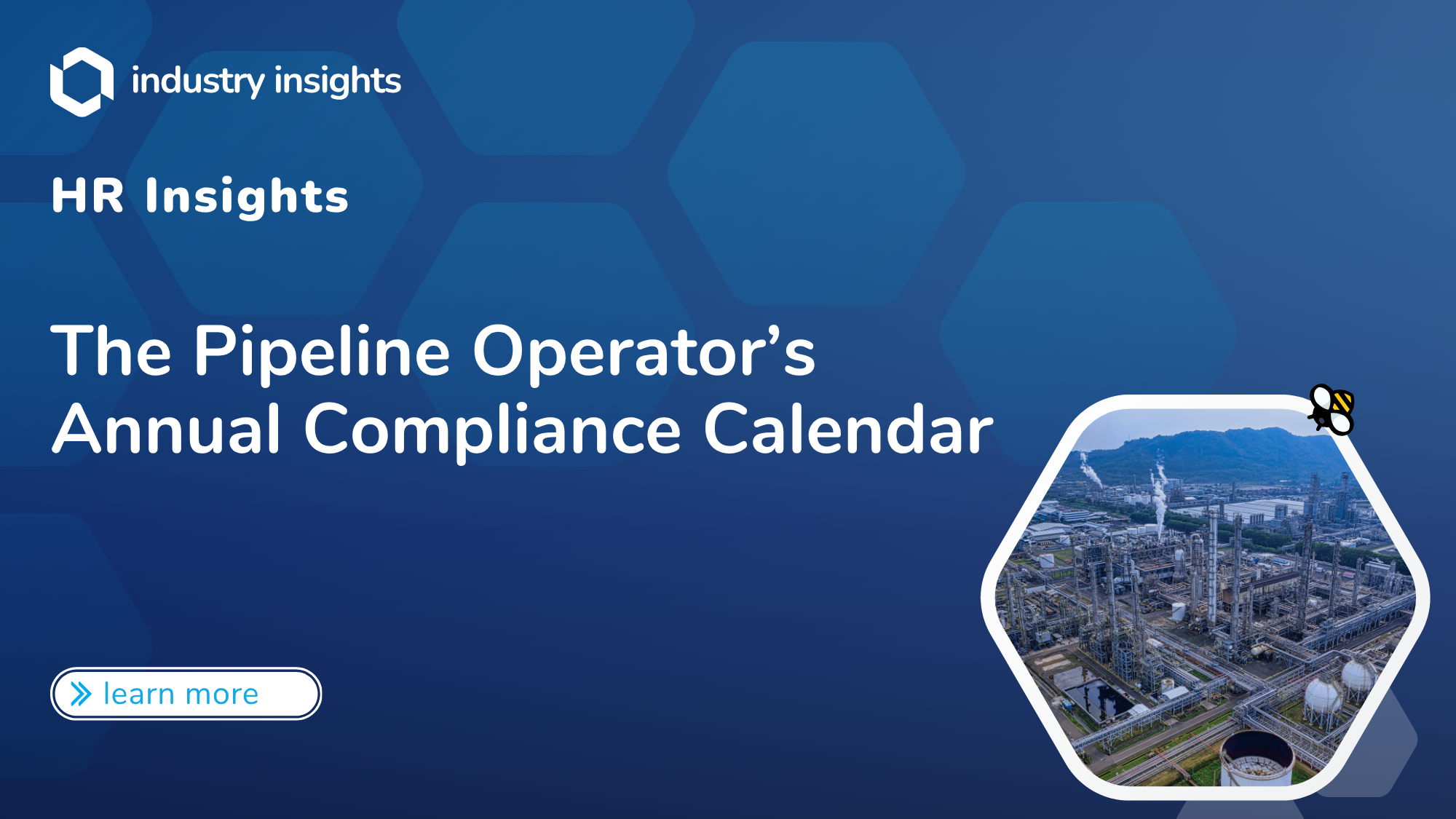
The Pipeline Operator's Annual Compliance Calendar
Executive Summary
If you work in Oil & Gas HR, pipeline compliance can feel like a wall of acronyms and deadlines. This whitepaper covers OSHA rules, PHMSA reporting, and DOT drug and alcohol program rules — with a clear calendar to keep your team organized.
If you work in Oil & Gas HR, pipeline compliance can feel like a wall of acronyms and deadlines. The good news is that you do not need to be an engineer or a regulator to help your company stay organized.
At a basic level, this whitepaper covers three big buckets:
- OSHA rules about workplace injuries and illnesses.
- PHMSA rules about pipeline reporting and operator notifications.
- DOT / PHMSA drug and alcohol program rules for covered pipeline employees.
For most pipeline operators, the busiest time of year is late winter and early spring. OSHA electronic injury reporting generally runs from January 2 through March 2. OSHA Form 300A must be posted from February 1 through April 30. Many PHMSA gas-related annual reports and pipeline drug and alcohol MIS reports are due on March 15. Hazardous liquid and carbon dioxide annual reports are due on June 15 (OSHA, n.d.-a), (OSHA, n.d.-b), (OSHA, n.d.-c); (PHMSA, n.d.-a), (PHMSA, n.d.-b), (PHMSA, n.d.-c), (PHMSA, n.d.-d), (PHMSA, n.d.-e).
The biggest takeaway is simple: HR may not own every technical form, but HR often owns the people, records, approvals, and follow-up steps that make those filings possible. That is why a clear compliance calendar matters.
Quick Acronym Guide
Here is the plain-English version of the main agencies and terms:
- DOT: U.S. Department of Transportation.
- PHMSA: The federal agency inside DOT that regulates pipeline safety.
- OSHA: The federal agency that regulates workplace safety and injury recordkeeping.
- MIS report: A yearly summary of drug and alcohol testing program data for certain pipeline operators.
- OPID: An Operator Identification Number used by PHMSA to track pipeline operators.
If those abbreviations have ever made your eyes glaze over, you are in very good company.
Pipeline Compliance at a Glance
Key numbers every pipeline operator HR team needs to know
Key regulators
OSHA, PHMSA, and DOT govern pipeline compliance obligations
Fatality reporting window
Employers must report a work-related fatality to OSHA within 8 hours
Post-accident drug test deadline
Drug testing must be completed no later than 32 hours after a qualifying accident
Covered employees trigger MIS
Operators with more than 50 covered employees must submit a yearly drug and alcohol MIS report
The Annual Calendar
Pipeline Operator Compliance Deadlines
Click each deadline to see what happens and what HR should do
What This Really Means for HR
A lot of compliance work sounds technical, but the breakdowns usually happen in very ordinary places. A site manager forgets to send an injury report. A business unit changes names and nobody tells the OPID owner. A contractor count is wrong. The person who is supposed to certify a filing is on vacation. A collection vendor is not ready after hours.
That is why HR matters here.
In practical terms, HR often helps control:
- Employee counts
- Contractor coordination
- Establishment records
- Approval routing
- Document retention
- Communication during urgent incidents
That is not glamorous work, but it is the work that keeps deadlines from turning into findings.
The Easiest Way to Think About the Year
Phase 1: January Through March is Reporting Season
This is when the paperwork pressure is highest. OSHA electronic reporting opens on January 2 and generally closes on March 2. OSHA posting starts on February 1. Many PHMSA gas annual reports and MIS reports are due March 15 (OSHA, n.d.-a), (OSHA, n.d.-b); (PHMSA, n.d.-a), (PHMSA, n.d.-b), (PHMSA, n.d.-c), (PHMSA, n.d.-d).
Plain-English Advice: do not wait until March to figure out who owns the data.
Phase 2: Spring is Still Busy
Even after March 15 passes, OSHA posting continues through April 30. If your company has hazardous liquid or carbon dioxide pipeline operations, June 15 is another important reporting date (OSHA, n.d.-b); (PHMSA, n.d.-e).
Plain-English Advice: if your company operates in more than one pipeline category, there may be more than one reporting season.
Phase 3: Summer Can Include Hazmat Registration
Some companies also need PHMSA hazmat registration, which follows a July 1 to June 30 cycle. That does not apply to every pipeline operator, but it is important for companies that offer or transport covered hazardous materials (PHMSA, n.d.-h).
Plain-English Advice: confirm whether this applies to your business entity. Do not guess.
Phase 4: Some Deadlines Are Not Annual
A few of the most serious deadlines are triggered by events, not calendar dates. OSHA severe injury reporting, PHMSA operator notifications, and post-accident testing all fall into this category (OSHA, n.d.-d); (PHMSA, 2012); (eCFR, 2026).
Plain-English Advice: these are the deadlines most likely to go wrong if your response depends on memory.
Five Practical Ways HR Can Make This Easier
1. Keep One Clean List of Worksites
For OSHA purposes, many obligations are based on the establishment, not just the company as a whole. A clean list of worksites, addresses, NAICS codes, and local contacts can save a lot of confusion later (OSHA, n.d.-a), (OSHA, n.d.-b).
2. Decide Who Owns Each Deadline Before the Deadline Month Starts
Every deadline should have a clear owner, a backup owner, and a reviewer. That sounds basic because it is basic. It is also the step people skip most often.
3. Include Contractors in Your Planning
For pipeline drug and alcohol reporting, contractor information can affect covered employee counts and reporting accuracy. If contractors perform covered functions, they should not be treated like an afterthought (PHMSA, n.d.-d).
4. Treat Company Changes as Compliance Events
Acquisitions, divestitures, name changes, and responsibility shifts may sound like legal or finance matters, but they can also trigger PHMSA notifications (eCFR, 2026).
5. Build an After-Hours Response Plan
Fatality reporting, severe injury reporting, and post-accident testing do not always happen during business hours. A phone list and a simple step-by-step checklist can be more valuable than a 40-page manual nobody reads (OSHA, n.d.-d); (PHMSA, 2012).
A Simple HR Checklist
Use this as a starting point.
- January: Confirm covered OSHA locations, certifiers, reporting owners, and PHMSA reporting owners.
- February: Post OSHA Form 300A and check that March filings are on track.
- March: Finish OSHA electronic submission by March 2 and PHMSA gas and MIS reporting by March 15, if applicable.
- April: Keep OSHA postings up through April 30 and save proof.
- May and June: Prepare any hazardous liquid or carbon dioxide reporting due June 15.
- Year-Round: Watch for injuries, serious incidents, company changes, and post-accident testing triggers.
How Ready Is Your Pipeline Compliance Program?
5 questions to evaluate your readiness for OSHA, PHMSA, and DOT deadlines
Question 1 of 5
Who in your organization owns OSHA electronic injury reporting and Form 300A posting?
Conclusion
You do not need to memorize every regulation to help your company stay compliant. You do need to know:
- Which deadlines happen every year
- Which deadlines happen after an event
- Who owns the data
- Who signs off
- Who responds when something happens fast
That is where HR adds real value.
BlueHive can help HR teams stay on top of all of this by giving them a more organized way to manage compliance-related tasks, records, and workforce health requirements in one place. Instead of juggling spreadsheets, email chains, vendor follow-up, and last-minute reminders, teams can use BlueHive to improve visibility, support services like screenings and exams, and keep the next step clear across multiple locations or employee groups. For HR leaders trying to balance safety, compliance, and day-to-day people needs, that kind of structure can make the whole process feel a lot more manageable.
When the calendar is clear, compliance becomes much less mysterious and a lot more manageable.
Sources
- Electronic Code of Federal Regulations. (2026). 49 CFR § 191.22: National Registry of operators. https://www.ecfr.gov/current/title-49/part-191/section-191.22
- Occupational Safety and Health Administration. (n.d.-a). Injury tracking application (ITA). U.S. Department of Labor. https://www.osha.gov/300A/
- Occupational Safety and Health Administration. (n.d.-b). Recording. U.S. Department of Labor. https://www.osha.gov/recordkeeping/recording
- Occupational Safety and Health Administration. (n.d.-c). 1904.29 - Forms. U.S. Department of Labor. https://www.osha.gov/laws-regs/regulations/standardnumber/1904/1904.29
- Occupational Safety and Health Administration. (n.d.-d). Report a fatality or severe injury. U.S. Department of Labor. https://www.osha.gov/report
- Pipeline and Hazardous Materials Safety Administration. (2012). Post accident drug and alcohol testing [PDF]. U.S. Department of Transportation. https://www.phmsa.dot.gov/sites/phmsa.dot.gov/files/docs/ADB-12-02.pdf
- Pipeline and Hazardous Materials Safety Administration. (n.d.-a). Gas distribution integrity management program: Performance measures. U.S. Department of Transportation. https://www.phmsa.dot.gov/pipeline/gas-distribution-integrity-management/gas-distribution-integrity-management-program-performance-measures
- Pipeline and Hazardous Materials Safety Administration. (n.d.-b). GT IM performance measures. U.S. Department of Transportation. https://www.phmsa.dot.gov/pipeline/gas-transmission-integrity-management/gt-im-performance-measures
- Pipeline and Hazardous Materials Safety Administration. (n.d.-c). Gas gathering performance metrics. U.S. Department of Transportation. https://www.phmsa.dot.gov/rulemaking-implementation/gas-gathering/gas-gathering-performance-metrics
- Pipeline and Hazardous Materials Safety Administration. (n.d.-d). MIS reporting. U.S. Department of Transportation. https://www.phmsa.dot.gov/pipeline/drug-and-alcohol/mis-reporting
- Pipeline and Hazardous Materials Safety Administration. (n.d.-e). HL IM performance measures. U.S. Department of Transportation. https://www.phmsa.dot.gov/pipeline/hazardous-liquid-integrity-management/hl-im-performance-measures
- Pipeline and Hazardous Materials Safety Administration. (n.d.-f). Liquefied natural gas annual report form F 7100.3-1. U.S. Department of Transportation. https://www.phmsa.dot.gov/forms/liquefied-natural-gas-annual-report-form-f-71003-1
- Pipeline and Hazardous Materials Safety Administration. (n.d.-g). Underground natural gas storage: Key documents. U.S. Department of Transportation. https://www.phmsa.dot.gov/pipeline/underground-natural-gas-storage/underground-natural-gas-storage-key-documents
- Pipeline and Hazardous Materials Safety Administration. (n.d.-h). Registration information. U.S. Department of Transportation. https://www.phmsa.dot.gov/registration/registration-information
Stay Current on OSHA & Workplace Safety
State regulations change frequently. Track the latest updates in our Compliance Watch.
View OSHA & Workplace Safety Updates
Content Developer
69 articles
Chris Davis is a content developer at BlueHive, covering occupational health compliance, workplace safety, and industry best practices.
Related Services
Related White Papers
 White Paper
Well-to-Market Workforce Health Audit: Scoring Your Oil & Gas Compliance Pipeline
Chris Davis·9 min read White Paper
HR Essentials: Streamlining Workforce Compliance in Oil and Gas
Chris Davis·7 min read White Paper
Your Hiring Process is a Candidate Experience: How Occupational Health Steps Can Build Trust
Chris Davis·44 min readReady to streamline your occupational health program?
BlueHive connects you to 20,000+ clinics nationwide with real-time scheduling and results.